


Behind the scenes, allies of Donald Trump are reportedly urging conservative Supreme Court Justices Samuel Alito (76 years old) and Clarence Thomas (77) to consider retirement. Now.
The White House’s political logic is straightforward: retire now, while there’s a friendly president and Senate to confirm replacements. Wait, and you risk a Senate controlled by the other party that could stall—or outright block—the next nominee.
In other words, the question isn’t just who sits on the Supreme Court of the United States. It’s when the seat opens up.
And that’s where the real politics lives.
Crash Course: Why Timing Matters So Much
The Constitution gives Supreme Court justices lifetime tenure (“during good Behaviour”). The goal was insulation—keep judges above day-to-day politics.
But, in reality, it turned vacancies into political battlefields. And ones that can have huge effects on elections, especially for presidents who will be doing the nominating.
Because justices serve so long, openings are rare. And because they’re rare, each one is enormous. One seat can tilt the Court for decades.
So the system creates a quiet but powerful incentive for justices sitting on the bench: If you care about the political direction of the Court, you don’t just decide whether to retire. You decide when to retire.
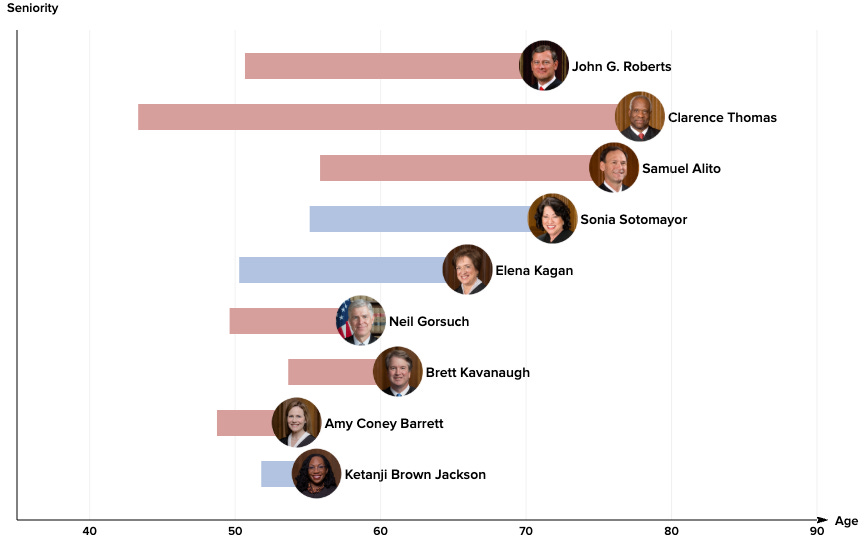
The Data Behind the Strategy
This isn’t just vibes—it’s backed by a long-term shift in how long justices serve and how old they are when they do it.
According to data compiled by the Federal Judicial Center:
Justices are being appointed younger than they used to be. Thomas was appointed to the Court back in 1991 at age 43.
They are serving longer than at almost any point in U.S. history.
The average tenure of SCOTUS justices used to hover around 16 years. Since 1970, it’s climbed past 23.
That combination matters.
You appoint someone in their late 40s or early 50s, and you’re not filling a seat—you’re locking in influence for a generation.
This Isn’t New—It’s Just More Obvious Now
Strategic retirements have been part of the Court for a while. But they’ve become more visible—and more expected.
Anthony Kennedy stepped down during a Republican presidency, allowing a like-minded replacement. Kennedy was replaced by 53 year old Brett Kavanaugh.
Stephen Breyer retired under Joe Biden after pressure from Democrats not to risk the seat. Breyer was replaced by 51 year old Ketanji Brown Jackson.
And conversely, Ruth Bader Ginsburg chose not to retire when Barack Obama could have replaced her—a decision that reshaped the Court after her death after Senate Republicans blocked her successor from receiving a hearing, let alone a vote.
Why the Pressure Exists More Now
Which brings us back to the current speculation around Alito and Thomas.
The calculation is straightforward. A president can nominate a justice, but the Senate decides whether that nominee ever reaches the bench. When the same party controls both, vacancies tend to move. When control is split, the process can grind to a halt.
The Senate’s rules matter here. For most of modern history, confirming a Supreme Court justice effectively required 60 votes to overcome a filibuster. That changed in 2017, when Republicans extended the so-called “nuclear option” to Supreme Court nominations, lowering the threshold to a simple majority. Since then, confirmations have depended far more on which party holds the chamber than on building bipartisan coalitions.
You can see the difference in recent history:
The Senate declined to take up Merrick Garland’s nomination in March 2016, leaving the seat open for months until after the 2016 election (which Trump won)
Four years later, Trump nominee Amy Coney Barrett was confirmed by Senate Republicans only 35 days before the 2020 election
Same institution, same constitutional roles, but very different political conditions, and very different results.
That’s the backdrop for any talk of retirement. A justice stepping down at the right moment all but ensures a successor. Waiting introduces uncertainty, especially with the Senate’s balance always one election away from changing.
The Bigger Question
Retirement isn’t the end of a justice’s influence. It’s the moment that determines who carries it forward.
Once you see it, it’s hard to unsee.
If Supreme Court power hinges on timing—on aligning retirements with favorable political conditions—then the system isn’t just about law.
It’s about political strategy.
Which raises a simple question: Should something this important depend on who retires at the right moment?
That’s why ideas like term limits or mandatory retirement ages keep coming up. Not because the Court is “too political,” but because the politics we have now is concentrated into a few, high-stakes decisions about when to leave.
The Bottom Line
The headlines will always focus on the next nominee.
But the real action often happens before that—quietly, behind the scenes, in conversations about timing, risk, and control.
Because on today’s Supreme Court, the most important decision a justice makes might not be how they rule.
It’s when they retire.