


Both Eric Swalwell and Tony Gonzales have now announced their resignations from the House, stepping down amid calls for their expulsion.
If you read my earlier piece on why expulsion was unlikely, this shouldn’t come as a surprise. Expulsion is rare. Pressure works faster. And resignation is how these stories usually end.
But their exits point to a deeper question that sits beneath every congressional scandal:
If Congress almost never expels its members, who (or what) has the power to hold them accountable between elections?
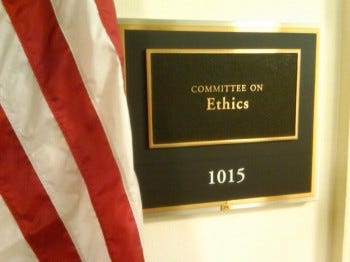
The Ethics System: Congress Polices Itself
At the center of the answer is the House and Senate Ethics Committees—bodies made up entirely of sitting lawmakers, evenly split between Democrats and Republicans. That structure is intentional. It’s meant to prevent one party from weaponizing ethics enforcement against the other.
But it also means that every investigation is shaped by the same political incentives that govern everything else in Congress.
The result is a system that exists, functions, and produces outcomes—but rarely in the way the public expects and almost never on the public’s timeline.
How an Ethics Investigation Starts
Most people assume Congress launches investigations the way prosecutors do: quickly, decisively, and in response to clear allegations.
In reality, the process is slower and more layered.
There are two main ways a case gets started.
The first runs through the Office of Congressional Conduct (OCC), an independent, nonpartisan body created to give the public a way in. Anyone—not just lawmakers—can submit a complaint. The OCC reviews those submissions, conducts a preliminary inquiry, and, if it finds reason to proceed, refers the matter to the Ethics Committee with a report of its findings.
The second path is internal. Members of Congress can file complaints directly, or the Ethics Committee can initiate an investigation on its own, often in response to media reports or emerging scandals.
What Happens Once a Case Is Opened
Once the Ethics Committee takes up a case, the process unfolds in stages, most of which happen out of public view.
It typically begins with a preliminary review—quiet fact-finding meant to determine whether a full investigation is warranted. If the committee votes to move forward, it can open an investigative subcommittee, issue subpoenas, conduct interviews, and gather documents.
From there, the committee can:
Dismiss the case
Issue a report with findings
Recommend punishment to the full House
In theory, that recommended punishment could include reprimand, censure, or even expulsion.
In practice, most cases never get that far.
Why the Process Takes So Long
Ethics investigations in Congress are not built for speed.
They often take months, and in some cases, years to resolve. Part of that is by design—members are cautious about due process, reputational harm, and setting precedents that could later be used against them.
But part of it is structural.
The committee is evenly divided between parties, which means disagreement can slow or stall progress. Investigations also operate alongside, not above, politics. Members are weighing not just the facts, but the political implications of acting on them.
There’s another constraint most people don’t realize: Ethics investigations don’t carry over indefinitely.
At the end of each Congress (every two years), unfinished investigations expire or must be reauthorized. That creates a natural clock—one that doesn’t always align with the pace of an investigation.
And then there’s the most common disruptor of all: Resignation.
When a member leaves office, the Ethics Committee loses jurisdiction. The investigation effectively stops—not because the questions are resolved, but because the committee no longer has jurisdiction.
Which is exactly what just happened with Swalwell and Gonzales.
Why Enforcement Feels So Weak
Put all of this together, and the pattern becomes clear.
The Ethics Committee is not absent. It’s active. It investigates, deliberates, and issues findings.
But it operates in a system where:
Members investigate their own colleagues
Bipartisan agreement is required to move forward
The process is slow by design
And resignation often ends the case before it concludes
That’s why formal punishment—especially something as severe as expulsion—is so rare.
Accountability, when it comes, usually arrives through other channels first: media scrutiny, party pressure, donor reaction, and voter backlash.
The Crash Course
Congress has rules. It has investigators. It has Ethics Committees. It has the constitutional authority to punish and even remove its own members.
But the system is built to move deliberately, not quickly—and to protect the institution as much as police it.
So when scandals break, the question isn’t just whether Congress can act.
It’s whether the system is built to act fast enough to matter.
And more often than not, it isn’t.
Good overview of self-policing inside Congress. It raises 2 new questions for me (1) how do these activities interact with more familiar law enforcement activities?, and (2) how much transparency does the public get into these “inside” inquiries?
As always thank you for explaining. Has there been an investigation initiated by the public?!