


GOP Texas Sen. John Cornyn voted with his party 91% of the time.
Louisiana Sen. Bill Cassidy: 90%.
Texas Rep. Dan Crenshaw: 89%.
Even Rep. Thomas Massie of Kentucky — the libertarian-ish, party-annoying, leadership-frustrating exception on this list — still voted with Republicans 73% of the time.
And yet all four lost their primaries.
Which tells us something important about modern Congress: party loyalty is no longer just about how you vote. It is about whether primary voters believe you are loyal enough.
That is a very different standard.
For most members of Congress, the scariest election is not the general election in November. It is the primary months earlier, when a much smaller, more ideological, more politically engaged slice of voters decides whether the incumbent gets to make it to November at all.
That fear shapes behavior.
It explains why members who privately want compromise often publicly perform purity. It explains why lawmakers who vote with their party 90% of the time can still be attacked as sellouts, squishes, RINOs, corporate Democrats, establishment hacks, or whatever the insult of the moment happens to be. And it explains why Congress can feel so much more partisan than the country as a whole.
Because the voters who reward bipartisanship are often not the voters who decide primaries.
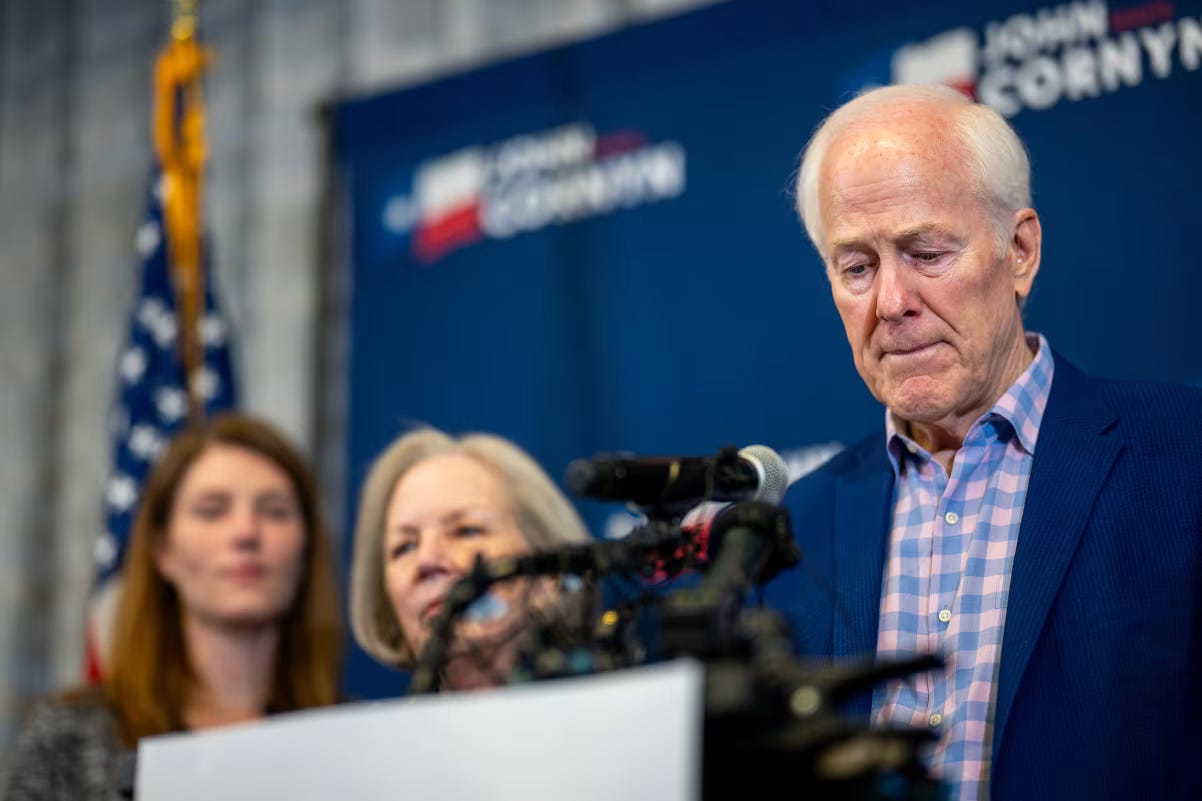
Cornyn is the clearest example. He was no liberal Republican. He voted with his party more than nine out of ten times, according to Quorum. But that was not enough to protect him in a Republican primary where Ken Paxton, backed by Trump, framed him as insufficiently loyal to the movement and the moment. Cornyn lost despite years of conservative voting, institutional seniority, and a record that would have looked very Republican in almost any earlier era.
That is the incentive structure in one sentence: members can vote with the party almost all the time and still lose for the handful of times they did not.
The math is brutal. A member who votes with the party 90% of the time still casts hundreds of votes in a Congress. That leaves plenty of material for a challenger, outside group, or cable-news segment to build a case around the exceptions. One vote for a bipartisan gun bill. One comment criticizing the party leader. One procedural vote that can be described as betrayal. One moment of independence that becomes the whole campaign.
Primary challengers rarely run by saying, “The incumbent was with us 90% of the time.”
They run by saying, “Here are the times they weren’t.”
And once that becomes the standard, the safest political move is not merely to vote with the party. It is to avoid giving anyone evidence that you ever seriously considered doing otherwise.
That is why this dynamic matters beyond the defeated incumbents. Their successors arrive in Congress having learned the lesson that won them the job: never give the base a reason to doubt you. Do not just be conservative or liberal. Be visibly, constantly, confrontationally conservative or liberal. Do not just vote the right way. Talk the right way. Post the right way. Pick the right enemies. Show the tribe you are fighting.
Then we wonder why Congress does not suddenly become more bipartisan after Election Day.
But members are not confused. They are responding to incentives.
We often say we want bipartisanship. And in surveys, lots of Americans do. They say they want compromise, problem-solving, and less performative conflict. But primary electorates often reward something else: certainty, confrontation, ideological discipline, and proof that their representative will not drift toward the other side.
That does not mean every primary voter is extreme or irrational. It means they are voting in a system that gives them enormous power. In many districts and states, the dominant party’s primary is the real election. Win that, and the general election is a formality. Lose it, and your 90% party loyalty record goes into a very sad PowerPoint labeled “Lessons Learned.”
So the next time a member refuses a bipartisan deal that seems popular, or dodges a compromise that looks obvious, remember the audience they may be most worried about.
Not the average, everday voter.
Not the Sunday show panel.
Not the general election opponent.
The primary voter who thinks 90% loyalty still leaves 10% too much room for betrayal.
It’s not the percentage of time that they voted with the party. It’s the issues that they voted against.
Trump and primary voters viewed Cornyn as insufficiently loyal due to several high-profile breaks, especially around the 2020 election and institutional norms. politico.comnbcnews.com
Main Issues Cited in the Campaign and Trump’s Endorsement
• 2020 Election Certification: Cornyn voted to certify Joe Biden’s Electoral College victory on January 6, 2021 (and announced beforehand he would not object based on unproven allegations). He split with Ted Cruz and many in the party who challenged results. Trump and Paxton framed this as disloyalty, especially since Paxton sued to overturn results in key states. politico.comtexasmonthly.com
• Post-January 6 Criticism: Cornyn condemned Trump’s “reckless and incendiary speech” leading to the Capitol riot (while voting to acquit him in the impeachment trial). He later suggested in 2023 that Trump’s “time has passed him by” and the party needed a new direction (before eventually endorsing him). texastribune.org
• SAVE America Act / Election Integrity Priorities: Trump criticized Cornyn for not fighting hard enough to eliminate or bypass the filibuster to pass this bill (voter ID, proof of citizenship, limits on mail-in ballots). Cornyn, a longtime institutionalist, defended Senate rules and was reluctant to change them. newsweek.com
• Other Past Tensions: Cornyn expressed skepticism about a full border wall (while supporting broader security), backed some legal protections for Dreamers (DACA recipients, labeled “amnesty” by critics), and called Paxton’s own impeachment proceedings an “embarrassment” to the party. texastribune.org
Trump’s late endorsement of Paxton (a week before the runoff) emphasized: “John Cornyn is a good man, and I worked well with him, but he was not supportive of me when times were tough.” Paxton positioned himself as the unwavering “MAGA Warrior.” ballotpedia.org