


Unless you’ve been completely ignoring the news, you know the U.S. and Iran agreed to a 14-day ceasefire. The pause in war was announced just minutes before President Trump’s 8 p.m. deadline, when he warned that if Iran didn’t back down he would bomb the country “back to the stone ages” and the “whole civilization will die.”
The immediate crisis may be paused. Now, the real work begins.
Over the next two weeks, both sides will try to turn that pause into a long term peace agreement. But, the two sides are working from two very different blueprints. Iran has issued a 10-point proposal. The U.S. has its own 15-point plan.
The core divide in two sentences: Iran wants sovereignty. The U.S. wants control through verification.
Where the Plans Clash
If you want to understand why this is hard to resolve, don’t read the headlines—look at the terms and where the two countries differ.
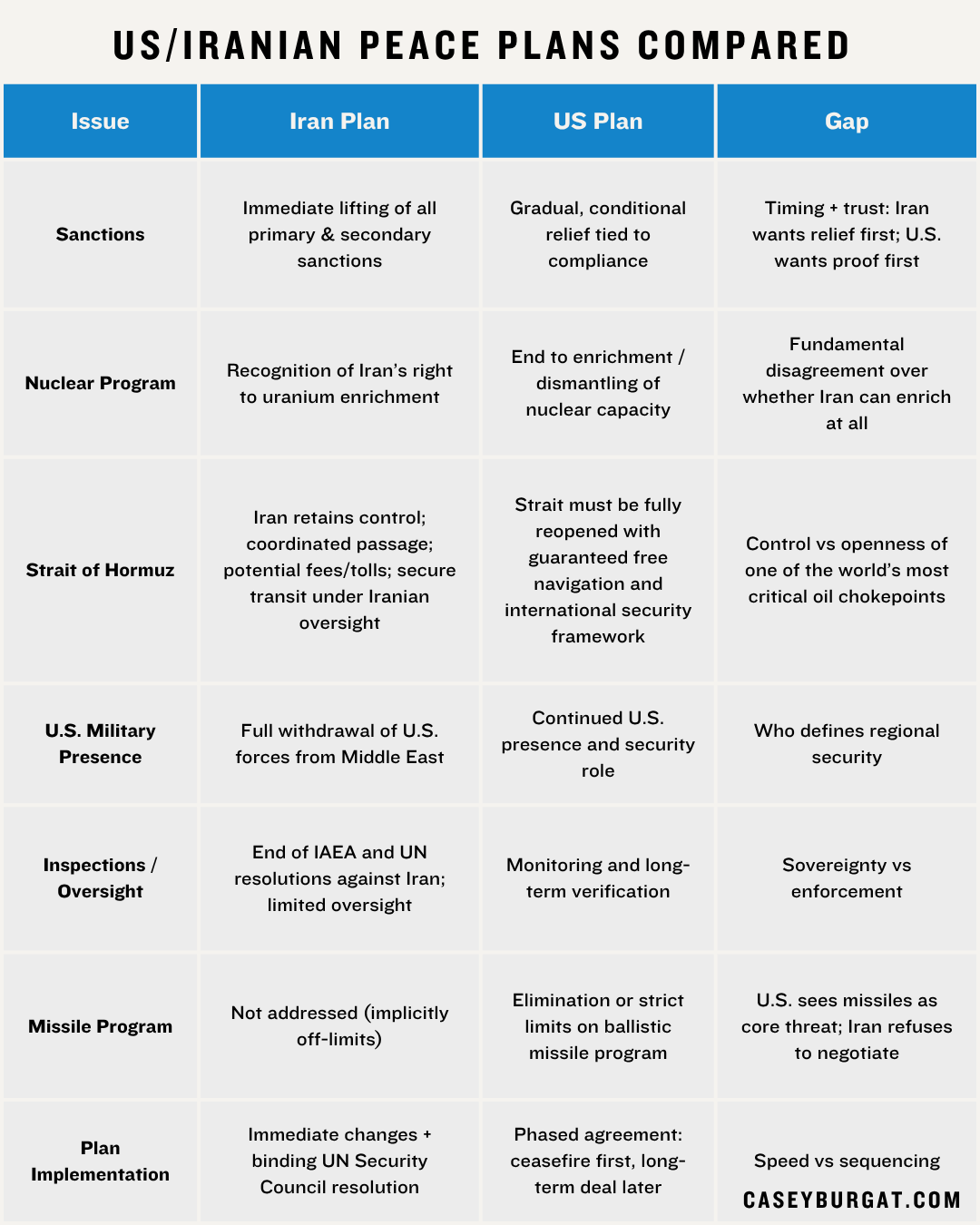
The Biggest Flashpoints:
The Strait of Hormuz
This is the one to watch. Roughly a fifth of the world’s oil passes through it. Iran wants control and leverage; The U.S. wants guaranteed open access.
The Nuclear Gap
Iran possesses roughly 440–460 kilograms of uranium enriched to 60%. Weapons-grade uranium is about 90% enrichment. That stockpile alone could be enough for roughly 9–10 nuclear weapons if further enriched.
Now layer in the proposals.
Iran’s position: Keep enrichment rights and retain its existing stockpile
U.S. position: Eliminate or drastically limit enrichment and remove that stockpile out of Iran’s control.
This isn’t only about whether Iran can build a nuclear weapon (which 99% of the world agrees is a non-starter). It’s about what to do with one that’s already most of the way there.
Bottom Line
What you’re watching over the next 14 days isn’t just diplomacy—it’s a test of whether two fundamentally different visions of security can be reconciled.
Iran wants relief, recognition, and control
The U.S. wants limits, inspections, and guarantees
If the gaps between these two different visions of peace don’t close—and close quickly—this ceasefire isn’t a solution.
It’s a countdown.
Thanks for laying out. Feeling very far apart!
Great piece explaining this situation (if that's what we want to call it). Chart lays it all out nicely and frankly, I don't see a lot of common ground.