


Alex Vindman had pretty much every financial advantage a Senate candidate could want in Florida.
The former White House staffer and Trump impeachment witness raised more than $16 million for his Democratic Senate campaign. His primary opponent, state Rep. Angie Nixon, raised less than $1 million.
Then voters showed up Tuesday and Nixon crushed him 56% to 44%.
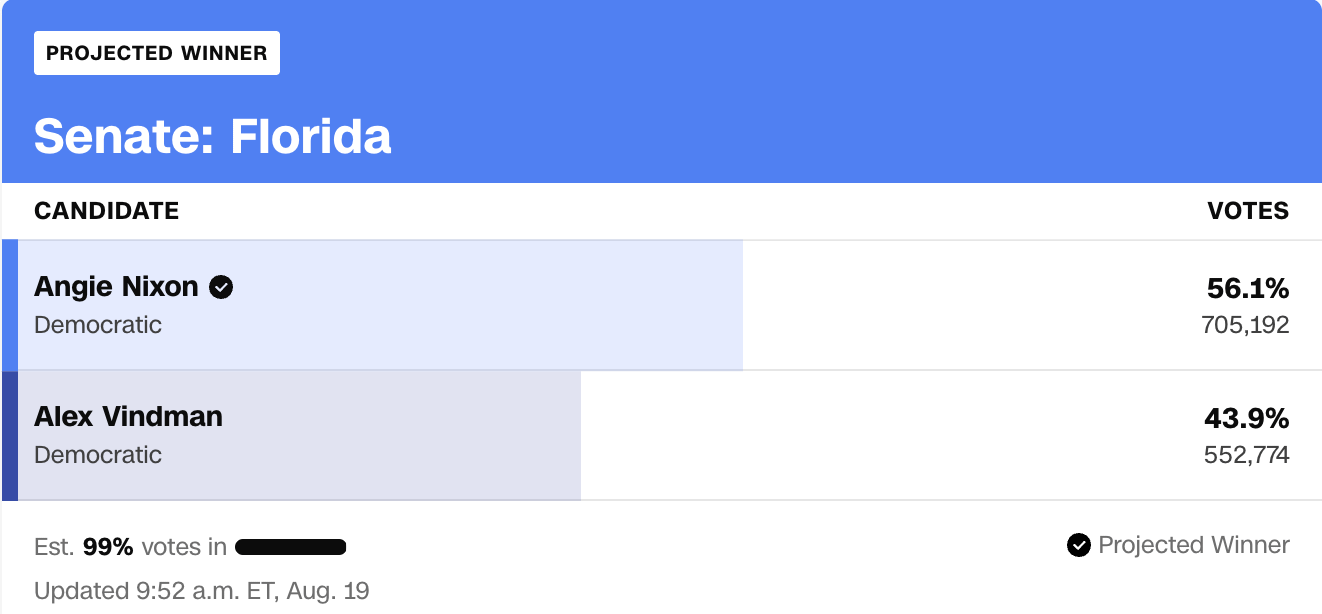
That is one expensive reminder of something we routinely get wrong about American elections: having more money gives you a distinct advantage but it does not guarantee you victory on Election Day.
Vindman isn’t alone this cycle, either. Look at some of the biggest Senate primaries of 2026:
In Michigan, Haley Stevens and her allies spent $52 million on TV and radio. Abdul El-Sayed and his allies spent $5.2 million. El-Sayed won.
In Minnesota, Angie Craig and her supporters spent $13.8 million, more than four times Peggy Flanagan’s $3.3 million. Flanagan won by 20 points.
In Texas, John Cornyn and his allies spent $58.8 million on advertising, compared with $8.2 million behind Ken Paxton. Paxton dominated the incumbent Cornyn 64%-36%.
In Georgia, Buddy Carter had $4.4 million in advertising behind him. Mike Collins had $925,000. Collins won.
Cornyn’s race is especially fun for campaign-finance nerds. His side spent about $45 for every vote he received in the runoff. Paxton’s side spent around $8 per vote. Cornyn still lost by 28 points.
To be fair, campaign funds matter a whole lot.
In the 2020 House elections, for example, the higher-spending candidate won about 88% of races. Money buys advertising, organizers, polling, mail, travel and, most importantly for unknown candidates, the chance to introduce yourself to voters.
But there is a giant causation problem hiding in that 88% statistic.
Strong candidates attract money. Incumbents raise money because donors expect them to win. Competitive challengers attract donors because people suddenly think they can win. My fellow nerd political science friends have been telling us for decades that sometimes money produces electoral strength, and sometimes electoral strength produces money.
But once voters know the candidates, the returns on another million dollars can get pretty lousy. At a certain point, the goal of raising money is to show that you can raise a lot of money. A big campaign war chest helps scare off would-be challengers, signals credibility, and forces the other side to raise even more to prove they are more viable. It’s a cold war mentality.
The better lesson is that campaign money is a megaphone. It can make sure voters hear your message. But, it can’t make them like it.
And lately, quite a few very rich campaigns have paid an awful lot of money to discover the difference.
Perfect - I just mentioned that in a response to another Substacker just the other day. You can throw money at someone all day long, and still it doesn’t always stick. Good for the people!
The people are speaking loud and clear. We want progressive candidates that work for us, not corporations or pacs.