


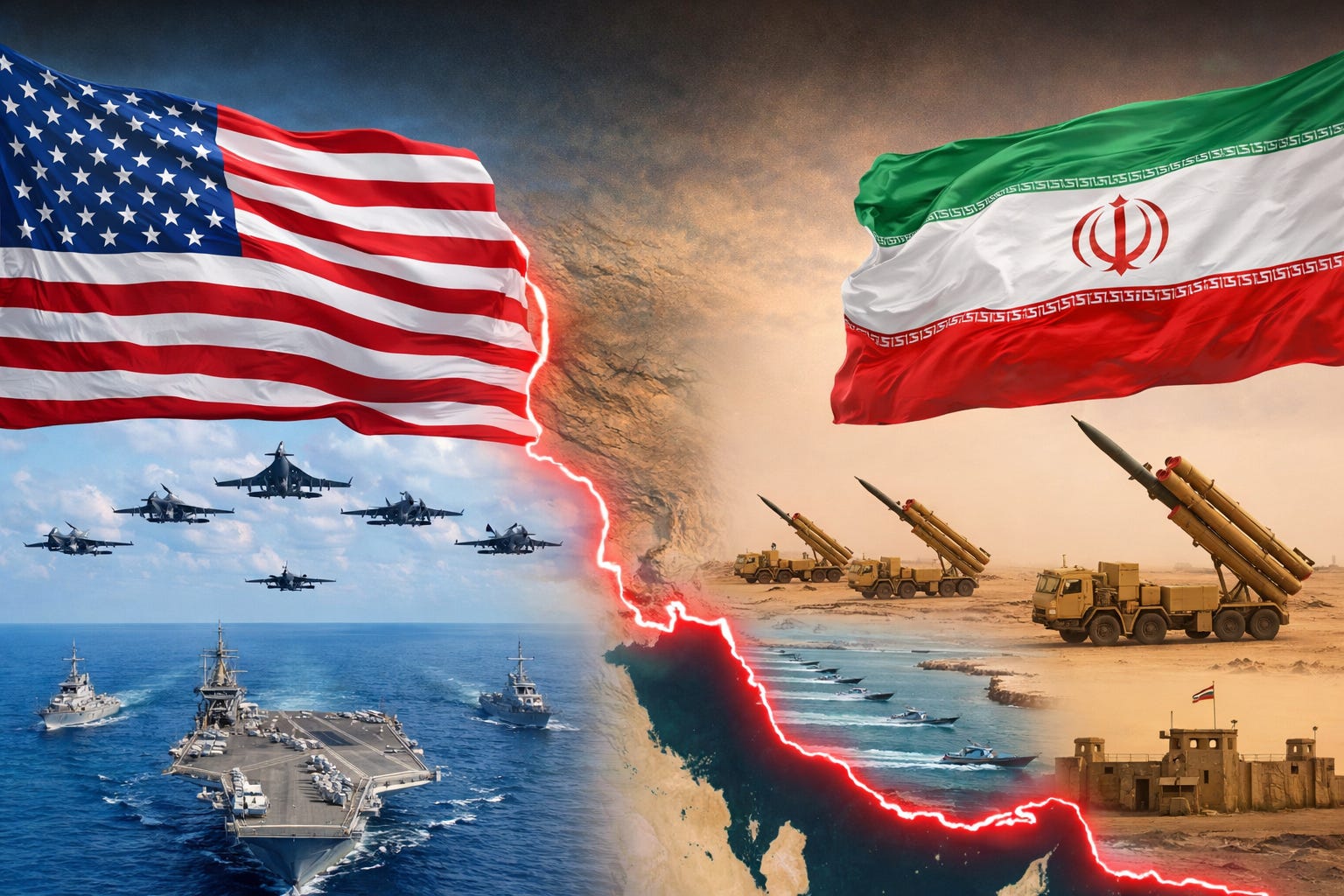
The United States has moved major military assets into the Middle East, including 50 fighter jets, two destroyers, submarines, and cruisers. And multiple news outlets are reporting that senior U.S. officials are actively preparing options for potential military strikes on Iran. No attack has been ordered, but the buildup is real, the warnings are public, and the diplomatic clock is ticking.
Here are the key questions people are asking — and the answers that help make sense of where things stand.
What’s happening now?
The U.S. has surged aircraft carrier strike groups, fighter jets, refueling tankers, bombers, and air-defense systems into and around the Middle East. Pentagon officials have told reporters that forces are being positioned so the president would have credible military options on short notice.
At the same time, reports are circulating that U.S. military planners are prepared for strikes if talks with Iran collapse. The administration says diplomacy remains the preferred path, but the scale of the buildup signals that Washington wants Tehran to believe the threat of force is real.
In short: the United States is preparing for the possibility of conflict while still publicly leaving the door open to negotiations.
This crisis is the product of years of unraveling agreements, mistrust, and escalation.
After the United States withdrew from the 2015 Iran nuclear deal during President Trump’s first term, sanctions were reimposed and Iran gradually expanded its nuclear activities. Efforts by later administrations to revive or replace the deal never fully succeeded.
More recently, tensions intensified after Israeli strikes on Iranian-linked targets and nuclear-related facilities, with U.S. backing. Those strikes deepened fears inside Washington that Iran is closer than ever to being able to produce nuclear weapons material, even if it has not publicly declared an intent to build a bomb.
At the same time, Iran continues to support armed groups across the region, maintain a growing missile program, and push back against U.S. influence in the Middle East. Each side views the other as the primary driver of instability.
Overlaying all of this are renewed waves of protests inside Iran, driven by economic distress, corruption, and anger at political repression. The Iranian government’s harsh crackdowns — and U.S. statements openly condemning Tehran’s human rights abuses and voicing support for protesters — have further hardened positions on both sides. For Washington, Iran’s internal unrest underscores the regime’s vulnerability; for Tehran, U.S. rhetoric reinforces the belief that Washington ultimately seeks to weaken or topple the government.
The result is a familiar pattern: stalled diplomacy, growing military pressure, and shrinking trust.
Why is the U.S. building up so much military force?
U.S. officials describe the buildup as serving two purposes.
First, deterrence. The administration wants Iran to believe that any move toward weaponization — or any major attack on U.S. forces or allies — would carry severe consequences.
Second, leverage. By showing it is serious about military options, Washington hopes to push Tehran into making concessions at the negotiating table, particularly on nuclear enrichment limits and inspections.
Privately, some U.S. officials also acknowledge that if diplomacy fails, any operation against Iran could be more than a single “pinprick” strike. That means planning now for the possibility of a sustained campaign and for defending U.S. bases and partners against retaliation.
Is there an imminent U.S. attack on Iran?
There is no public evidence that a strike order has been given.
What exists instead is readiness: forces in place, targets identified, and operational plans prepared. President Trump has said he prefers a diplomatic solution and has reportedly given Iran a short window — days, not months — to show meaningful progress.
That creates a narrow corridor where talks could still succeed, but also a situation where events could move quickly if the president decides diplomacy has failed.
What is Iran doing in response?
Iran has increased its own military signaling.
It has conducted naval exercises near key shipping lanes, including the Strait of Hormuz, and has warned that any attack on Iranian territory would be met with a strong response. Iranian leaders continue to insist their nuclear program is peaceful while rejecting U.S. demands that they fully dismantle enrichment capabilities.
Tehran’s strategy appears to be a mix of defiance and negotiation: demonstrate it can impose costs if attacked, while still engaging indirectly in talks to avoid full-scale war.
Are nuclear talks still happening?
Yes, but they are fragile and lack specifics.
U.S. and Iranian officials are communicating through intermediaries in Europe. Iran is expected to submit a written proposal outlining what limits it might accept and what sanctions relief it wants in return.
American officials say the sides remain far apart, especially on:
How much uranium Iran can enrich
How intrusive inspections would be
Whether Iran must curb missile development and regional proxy activity
Negotiations exist, but no breakthrough has been announced.
What are the major risks of escalation?
Any U.S.–Iran conflict would almost certainly extend beyond a single exchange of strikes.
Iran could target U.S. bases, allies such as Israel, shipping in the Persian Gulf, or energy infrastructure. That would risk drawing in additional countries and disrupting global oil markets.
There is also the risk of miscalculation: an incident meant as a signal could be interpreted as the start of a larger attack, triggering a rapid spiral.
Even officials who believe pressure is necessary acknowledge that once fighting begins, controlling its scope becomes difficult.
What would a US attack look like?
Current planning emphasizes air and naval power rather than ground invasion.
That means carrier-based aircraft, long-range bombers, cruise missiles, cyber operations, and electronic warfare aimed at nuclear facilities, air defenses, missile sites, and command-and-control systems.
Large numbers of U.S. ground troops are not being positioned for an Iraq-style occupation, but forces are being prepared to defend bases and allies from retaliation.
Could diplomacy still succeed?
Yes — but…
Both sides have incentives to avoid war. Iran risks devastating damage to its economy and infrastructure. The U.S. risks another open-ended Middle East conflict. Plus, the game theory on how post-attack responses can go sideways once they are actually carried out.
Whether a compromise emerges depends on whether Iran is willing to accept tighter nuclear limits and whether the U.S. is willing to offer meaningful sanctions relief in return.
Right now, neither side is showing much public flexibility.
Why does this matter beyond the Middle East?
A war between the U.S. and Iran would ripple across global politics and the world economy.
Energy prices could spike. Shipping routes could be disrupted. Relations among major powers — including Russia, China, and European allies — would be tested. And the future of nuclear nonproliferation efforts would be put under severe strain.
Bottom line: The United States and Iran are locked in a familiar but dangerous cycle of pressure, threats, and stalled diplomacy. Military preparations are real, but war is not inevitable. What happens in the next days and weeks will determine whether this moment becomes another crisis defused — or a conflict unleashed.