


Democrats won both chambers of Congress Tuesday, and by pretty substantial margins. But the final seat counts are only part of the story.
Who voted differently? Where did Republicans lose ground? Did redrawing congressional maps help? And how much did all those billions in campaign spending actually accomplish?
My five takeaways.
1. Trump’s 2024 coalition didn’t hold
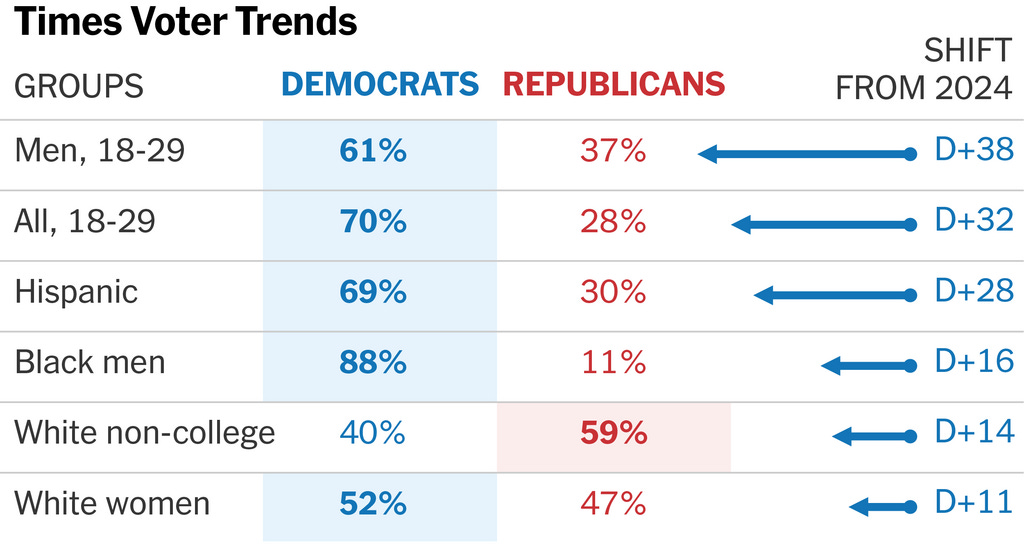
Remember all the attention paid to Trump’s gains with younger voters, Hispanic voters, and Black men in 2024? Well, those gains didn’t hold up particularly well.
According to early voter estimates, 70% of voters under 30 backed Democrats, including 61% of young men. Hispanic voters favored Democrats 69% to 30%. The Democratic margin shifted 38 points among young men and 28 points among Hispanic voters compared with 2024. (Le Monde)
Even white voters without college degrees, who still favored Republicans 59% to 40%, moved 14 points toward Democrats.
These are preliminary survey estimates, not final vote counts, but the direction is pretty unmistakable.
2. The country moved left. Almost everywhere.
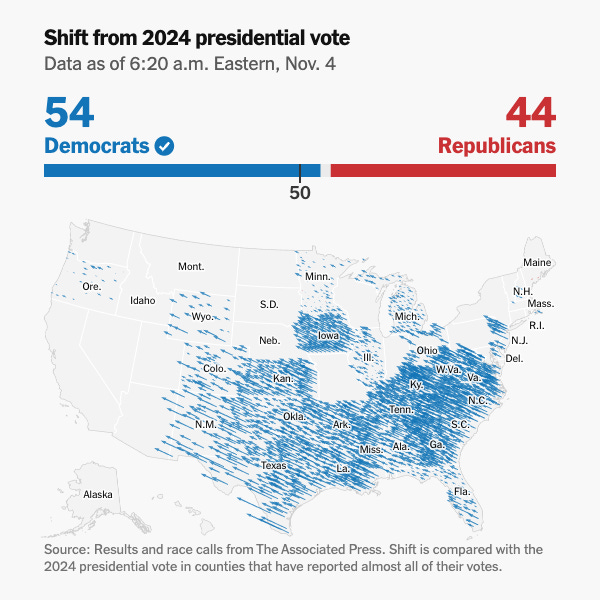
This wasn’t just Democrats running up their margins in New York and California.
According to Reuters, Republicans lost vote share in 99% of roughly 2,200 counties with substantially completed counts, compared with Trump’s 2024 performance. Their share fell an average of eight percentage points across those counties. (Reuters)
Urban, suburban, rural, wealthy, poor. It was an extraordinarily broad shift. That doesn’t mean every individual voter switched parties, but it does tell us the backlash wasn’t confined to a few battlegrounds.
3. Big majorities today. Not so big historically.
Two things can be true.
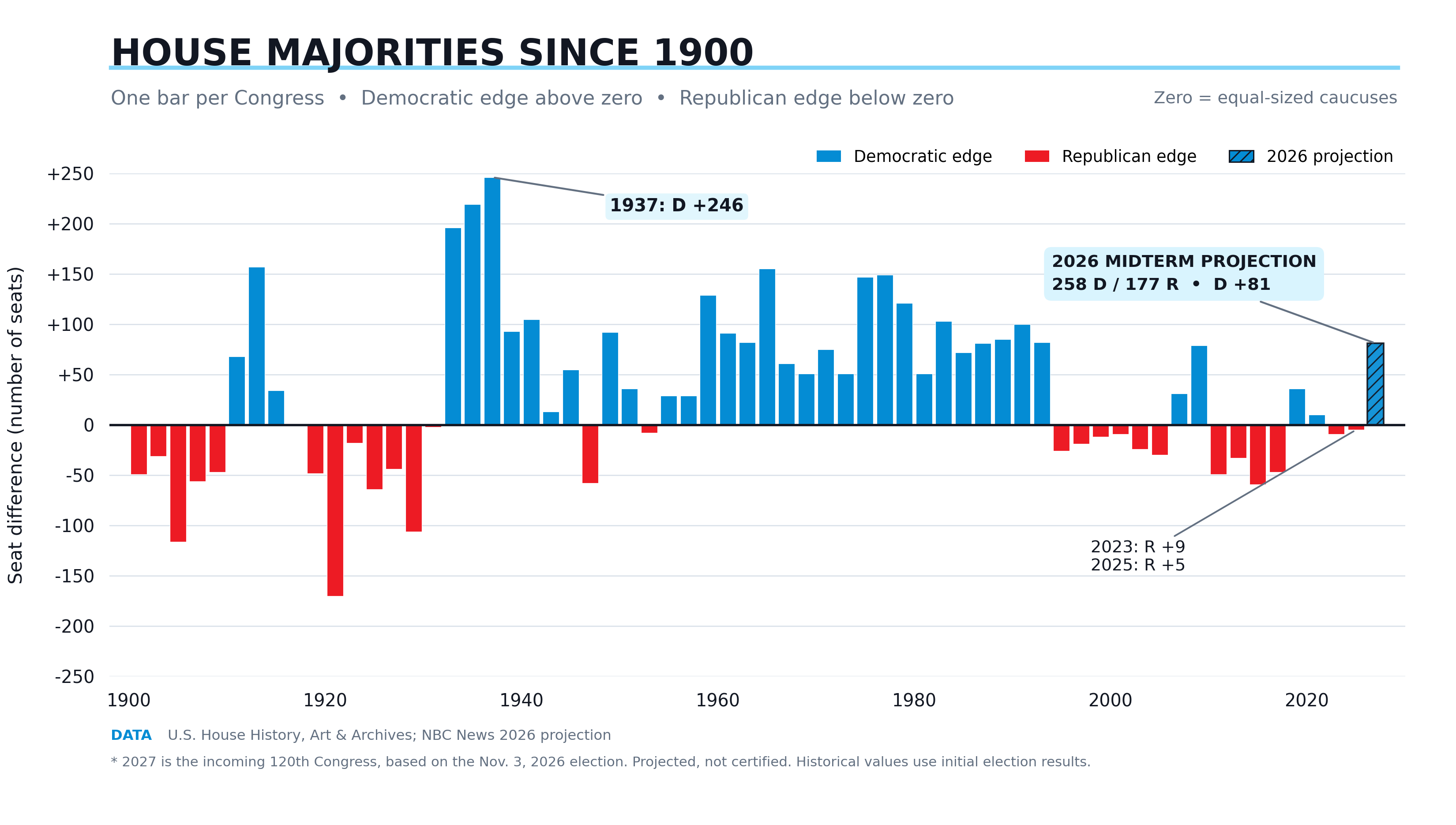
Democrats are projected to hold 258 House seats to Republicans’ 177, an 81-seat advantage and their largest since 1993. (Sky News/NBC)
But look at the longer history. Democrats held a 246-seat advantage in 1937 and a 149-seat advantage in 1977. Today’s projected majority, while substantial by recent standards, is nowhere near those historic margins.
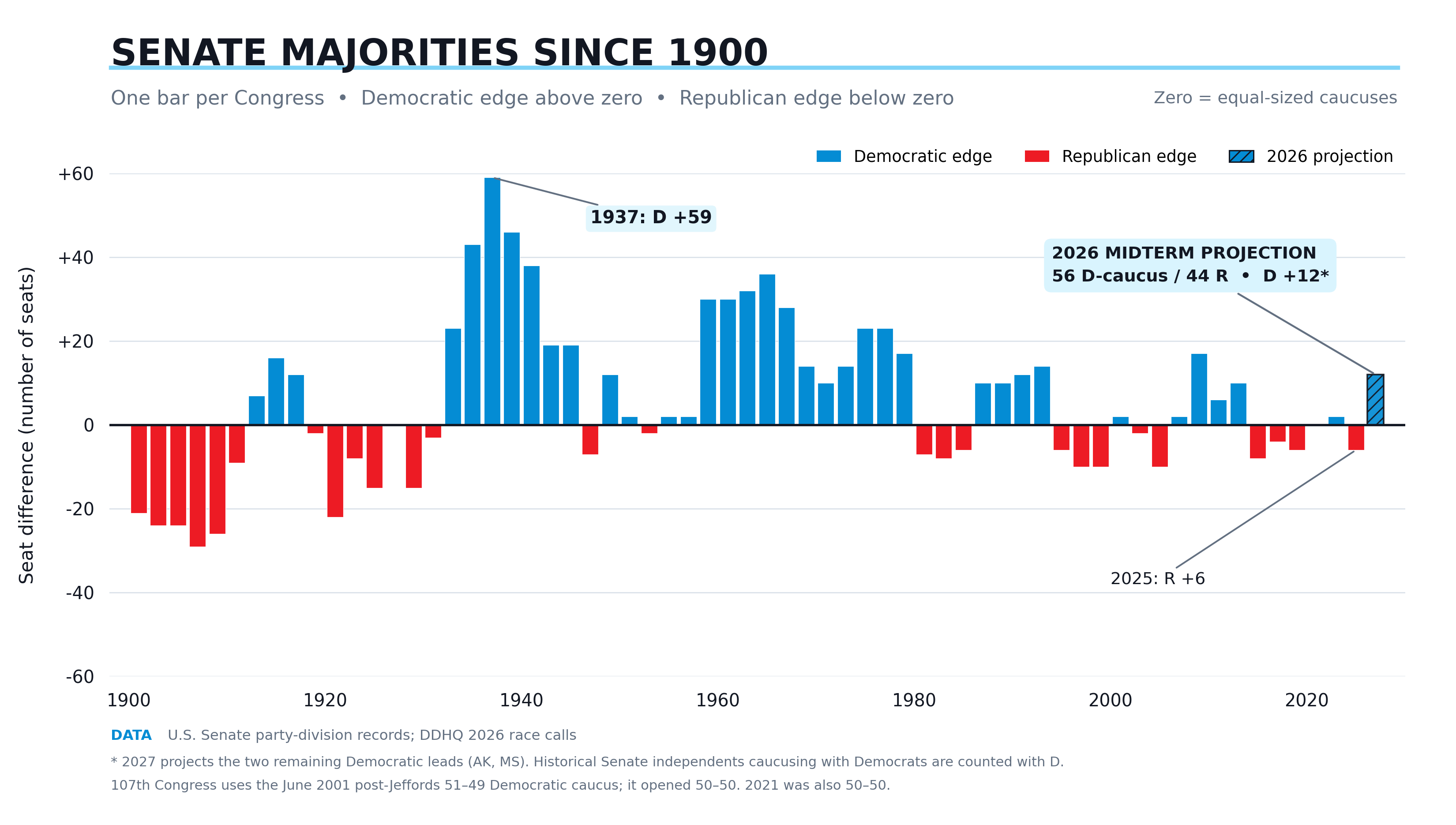
The Senate tells a similar story. Democrats already have control, with a projected 56–44 caucus advantage if their leads in the two outstanding races hold. That would be their largest advantage since 2009, but nowhere near the 59-seat gap in 1937.
4. The great gerrymandering backfire
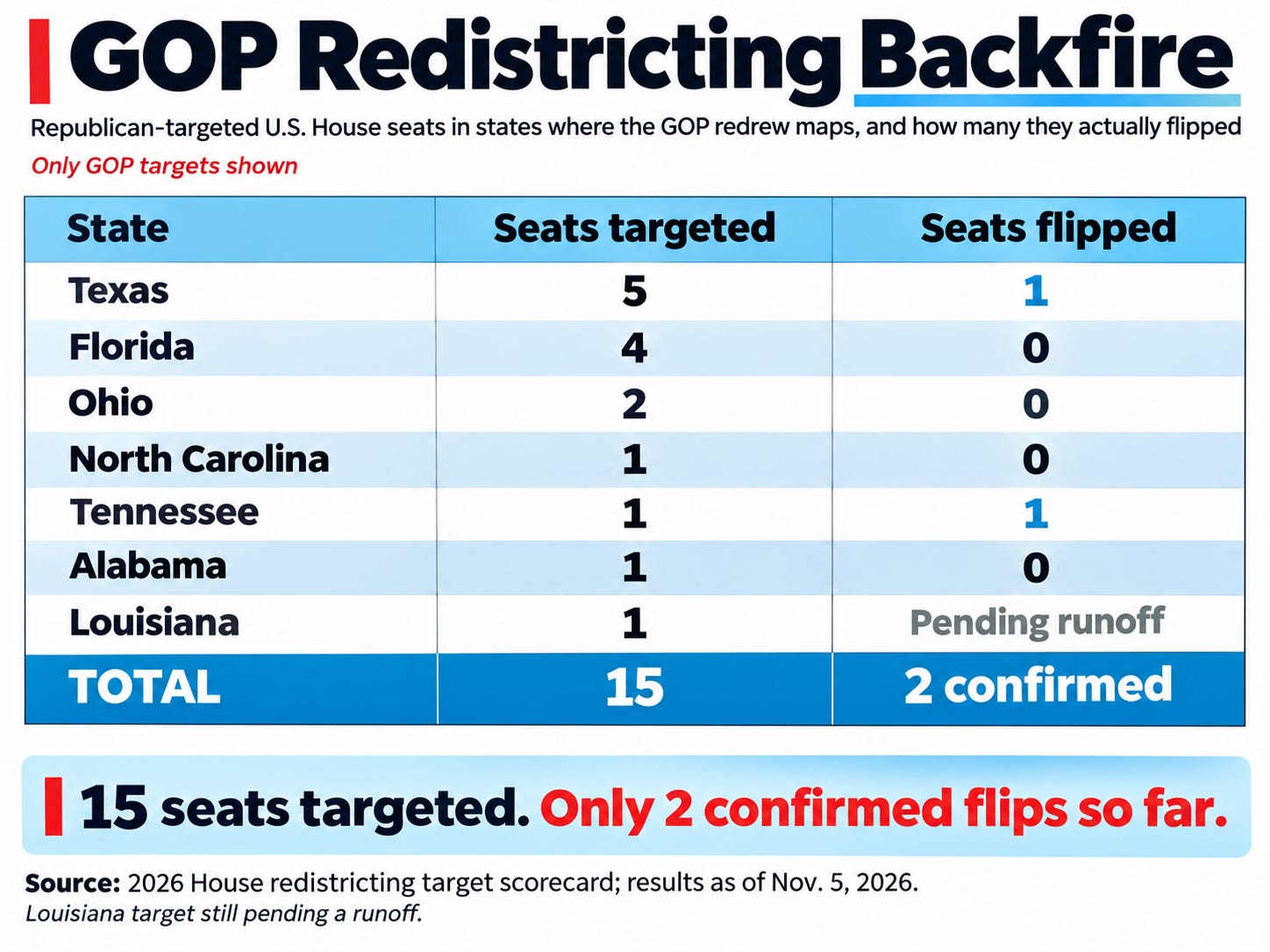
Republicans spent much of the past year redrawing congressional maps to help them keep control of the House. Across seven states, they targeted 15 Democratic-held seats they hoped to flip.
So far, they’ve flipped just two. One in Texas and another in Tennessee. Democrats held 10 of the targeted seats, with three races still unresolved. (ABC News)
California Democrats, meanwhile, responded to Texas’s redistricting with their own map designed to flip five Republican-held seats. They went five for five. (Associated Press)
5. All that money couldn’t buy a victory
Republicans and their allies spent an estimated $2.6 billion on advertising in competitive races, compared with $1.8 billion by Democrats. They still lost both chambers. (Washington Post)
Some individual examples are even more striking.
In Georgia’s governor’s race, Republican Rick Jackson raised approximately $222 million, much of it self-funded, compared with Democrat Keisha Lance Bottoms’s $11.7 million. Bottoms won. In Georgia’s 14th House district, the reverse happened: Democrat Shawn Harris raised $8.4 million to Republican Clay Fuller’s $2.2 million. Fuller won. (Axios)
Money matters in elections. A lot. But it’s not a substitute for the political environment or a candidate voters actually want.
And this year, Republicans discovered just how expensive losing can be.