


Senator Lindsey Graham died unexpectedly over the weekend, and South Carolina had a new senator by Tuesday. Republican Gov. Henry McMaster appointed Graham’s sister, Darline Graham Nordone, to serve the final months of his term.
Meanwhile, Sen. Mitch McConnell remains a senator from neighboring Kentucky even though he has been away from the Capitol since mid-June recovering from a fall and pneumonia. He says he is not yet healthy enough to return.
Those two cases provide nearly the entire crash course. Death creates a vacancy. Illness does not.
When is a congressional seat actually vacant?
A seat generally becomes vacant when a member dies, resigns, is expelled, or otherwise leaves office.
A serious illness, hospitalization, or lengthy absence does not automatically remove a lawmaker. There is no congressional version of the 25th Amendment and no “acting senator” who can temporarily cast votes. Unless the member resigns or the seat otherwise becomes vacant, the member remains in office.
That means McConnell’s staff can continue working and he can remain involved from rehabilitation, but Kentucky cannot temporarily replace him simply because he is absent.
Once a seat truly becomes vacant, the House and Senate follow very different rules.
The House always requires an election
The Constitution requires vacant House seats to be filled through an election. A governor cannot appoint a temporary representative, even when the vacancy leaves a district without a voting member for months and months.
State law controls nearly everything else, including:
When the governor must announce the election
How quickly the election must occur
Whether parties hold primaries, conventions, or committee votes
Whether the election can be combined with an already scheduled primary or general election
Whether a runoff is required
That creates significant variation. During the 118th Congress, House special elections occurred an average of 120 days after the vacancy, with individual waits ranging from 67 to 195 days.
The former member’s congressional office does not simply shut down. House staff continue handling constituent services under the supervision of the Clerk of the House until a successor is elected. The district simply has no one who can vote on legislation during that period.
The easy rule for the House is: no appointments to the House.
The Senate lets each state choose a system
The 17th Amendment requires Senate vacancies eventually to be filled by voters, but it allows each state legislature to decide whether the governor may appoint someone temporarily.
The 50 states fall into three broad categories.
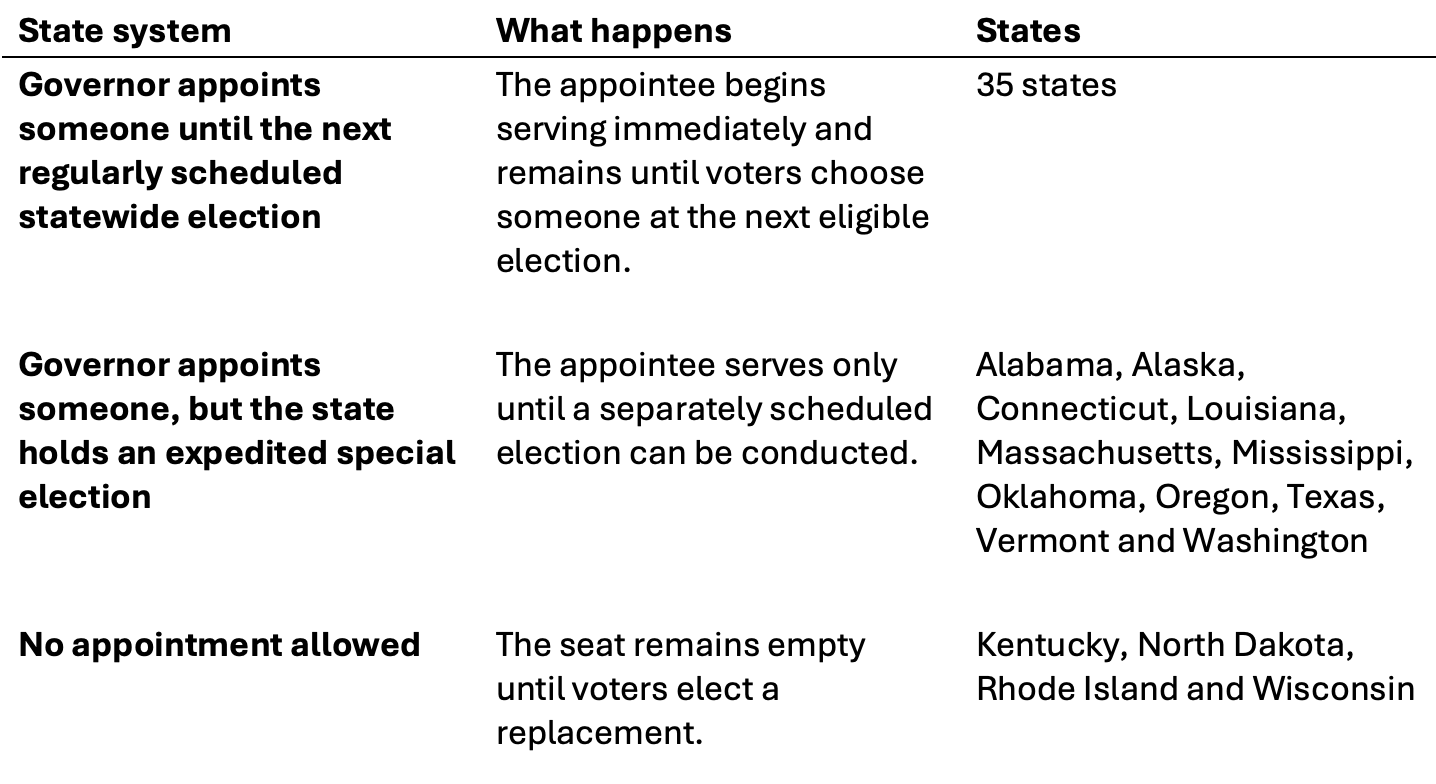
In other words, 46 states allow a governor to make an interim appointment in at least some circumstances. Four states require the public to choose from the start.
35 states normally wait until the next general election
Even within this group, the fine print matters.
Ten require the appointee to belong to the same party as the senator who left office: Arizona, Hawaii, Kansas, Maryland, Montana, Nevada, North Carolina, Utah, West Virginia and Wyoming.
Kansas and Utah further limit the governor to a list of three prospective replacements. Twenty-one states have election-calendar deadlines that can push the public vote to the following year or even the second general election after the vacancy.
So “the governor appoints someone” can mean anything from broad personal discretion to choosing one same-party candidate from a tightly controlled shortlist.
South Carolina and Kentucky show the difference
South Carolina gives its governor broad appointment power and does not require the temporary senator to belong to the departing senator’s party.
McMaster selected Graham’s sister, who will serve until Graham’s current term expires in January. Because Graham’s seat was already scheduled for election in November, South Carolina Republicans will hold a new primary on August 11 to select a nominee for the next full six-year term.
Kentucky follows the opposite model. Its legislature changed state law in 2024 to eliminate gubernatorial Senate appointments altogether. If McConnell were to resign or die before his term ends, Democratic Gov. Andy Beshear could not appoint a temporary replacement. The seat would remain vacant until a special election produced a winner.
McConnell’s illness therefore reduces Republicans’ available votes when he is absent, but it does not change the official number of senators or activate Kentucky’s vacancy law.
TLDR:
Remember three rules.
House vacancy: voters elect the replacement.
Senate vacancy: check the state law, but odds are Gov. has some appointment power.
Sick or absent lawmaker: the seat is still occupied unless the member actually leaves office.
In a closely divided Congress, the difference between an absent member, an empty seat, and an appointed replacement can determine what passes long before voters get their say.
Thank you. I keep learning!