


The Trump-Iran peace plan (memo? agreement? framework?) is one of those agreements that sounds simple until you read the terms and realize the entire thing is basically one giant diplomatic group project.
It ends the shooting now. It reopens one of the world’s most important oil routes. It gives Iran economic relief. It gives the U.S. and Iran 60 days to negotiate the much harder nuclear deal. And it leaves a lot of the most important questions for later.
So here’s the quick FAQ, starting with a comparison to the 2015 Iran nuclear agreement negotiated and signed during the Obama years. Use this so you can judge for yourself as to whether this is the tougher deal Trump promised after ripping up the 2015 JCPOA or a very expensive 60-day bet.
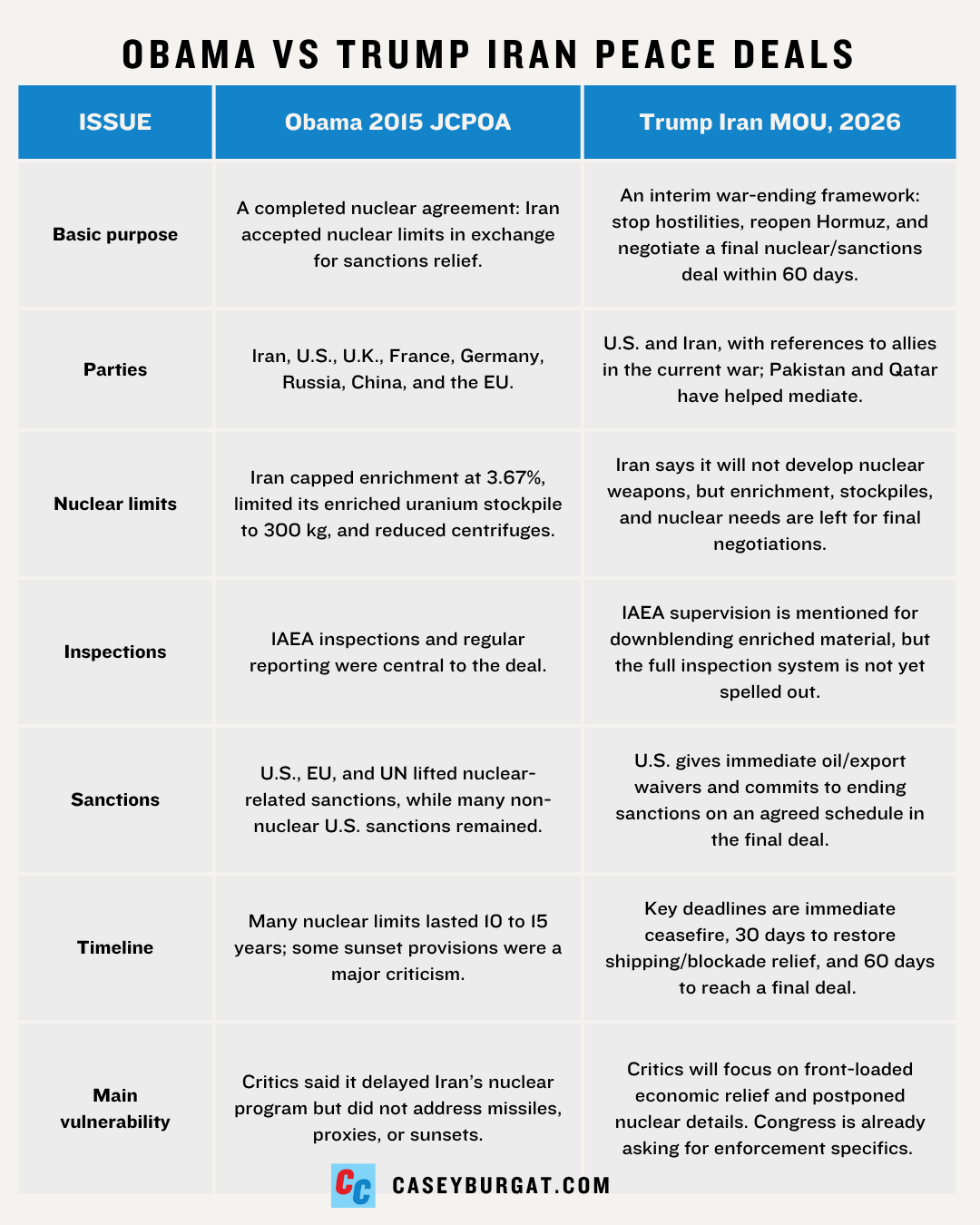
And now on to the FAQ:
1. Is this actually a peace deal?
Sort of.
The current agreement is best understood as an interim memorandum of understanding, or MOU. That is diplomatic language for “we have agreed to the framework, now everyone please stop firing missiles while we figure out the details.”
The immediate promise is that the war stops. The MOU says the United States, Iran, and their allies in the current conflict will end military operations on all fronts, including Lebanon. It also says the U.S. and Iran will respect each other’s sovereignty and stop threatening or using force against one another.
But this is still an opening agreement, not the final one. The current deal is designed to stop the fighting and create a 60-day window to negotiate the much harder questions about Iran’s nuclear program, sanctions, inspections, and enforcement.
2. What happens with the Strait of Hormuz?
This may be the most important practical (and political) part of the agreement.
The Strait of Hormuz is one of the world’s most important energy chokepoints. A huge share of global oil (about 20%) moves through it, which means trouble there does not stay there. It shows up in shipping costs, energy markets, gas prices, and the blood pressure of every economist who has ever said the word “volatility” on television.
Under the MOU, the U.S. agrees to begin lifting its naval blockade immediately and fully end it within 30 days. Iran agrees to restore safe commercial passage through the Strait within 30 days and allow ships to pass without charge for 60 days.
Translation: the deal is trying to reopen the oil spigot.
The “no charge” part matters too. Iran had pushed for some kind of toll or service-fee arrangement for vessels moving through the Strait. This agreement appears to freeze that fight for now while leaving future talks open with Oman and other Persian Gulf states.
3. What are the key deadlines?
There are three big ones.
The ceasefire and end of military operations are supposed to happen immediately.
The U.S. blockade and Iran’s restrictions on commercial passage through Hormuz are supposed to be fully resolved within 30 days. If the deal is treated as starting on June 15, that puts the major shipping deadline around July 15.
The U.S. and Iran have 60 days to negotiate a final agreement. Using the same June 15 starting point, that puts the final-deal deadline around August 15.
That 60-day clock is the whole ballgame. During that period, Iran is supposed to maintain the current status of its nuclear program. The U.S., meanwhile, agrees not to impose new sanctions or deploy additional forces in the region.
Easy. Except for the minor detail that the underlying dispute has been torturing diplomats, presidents, inspectors, generals, prime ministers, and cable-news guests for decades.
4. What does each side get?
Iran gets immediate economic breathing room.
The MOU says the U.S. Treasury will issue waivers allowing Iran to export crude oil, petroleum products, petrochemicals, and related services. That includes the boring-but-essential stuff that makes trade work: banking, insurance, and transportation.
The deal also says restricted Iranian funds will be made available under procedures still to be negotiated. And there is a much bigger promise: the U.S. agrees to work with regional partners on a reconstruction and economic development plan for Iran worth at least $300 billion.
That will be one of the political flashpoints. Supporters will call it the price of peace. Critics will call it a massive reward before Iran’s nuclear program is fully locked down. Both arguments will be available in convenient yelling size.
The U.S. gets an end to the war, the reopening of Hormuz, a promise from Iran not to develop or procure nuclear weapons, and a 60-day runway to negotiate a final nuclear deal.
The risk is sequencing. Iran gets real economic relief early while the U.S. gets promises and a negotiating window. Whether that was smart diplomacy or a dangerous concession depends almost entirely on what the final agreement says.
5. What does the plan say about Iran’s nuclear program and oversight?
This is where the agreement is both important and incomplete.
Iran reaffirms that it will not develop or procure nuclear weapons. The MOU also says Iran’s enriched uranium stockpile will be addressed through a mutually agreed mechanism, including at least some on-site downblending under International Atomic Energy Agency supervision.
But the biggest nuclear questions are left for the final agreement. How much enrichment, if any, will Iran be allowed to keep? What happens to its existing enriched uranium? How intrusive will inspections be? Who verifies compliance? What happens if Iran cheats?
Those are not side questions. Those are the deal.
The oversight language also needs more detail. The MOU creates an “executive mechanism” to monitor implementation and says the final agreement will be backed by a binding United Nations Security Council resolution. That sounds serious, but it is still far thinner than the 2015 JCPOA, which included a more developed structure for IAEA inspections, reporting, enforcement, and sanctions snapback.
That is also why Congress is already circling. If the final deal includes major nuclear commitments and sanctions relief, lawmakers will demand the text, the verification details, and a chance to review it.
So the simplest bottom line is this: the Trump Iran plan is a ceasefire, a Hormuz reopening agreement, an economic relief package, and a 60-day bet that a final agreement can be hammered out.
If the bet works, Trump will say he ended yet another war a war, reopened a critical global oil route, and forced a new nuclear agreement. (The other side will obviously respond with “you only needed to do those things after breaking them yourself.”)
If it fails, the U.S. may have given Iran early economic relief without locking down the nuclear program.
For now, the deal is less a final answer than a very expensive countdown clock. And the clock is already ticking.
Brutal how badly Trump got Art of the Deal-ed