


The House and Senate have both gone home for the midterms.
The House cast its last votes on September 16, almost two full months before Election Dat. The Senate followed them out of town on September 30. Other than brief pro forma sessions where essentially no business gets done, neither chamber is coming back until November 9.
Which gives us a pretty good opportunity to ask a question people love asking about Congress:
How much are these people actually working?
There are lots of bad ways to answer that question. Counting “days in session,” for example, gets messy fast because Congress can technically convene for a few minutes—or even seconds—and have it count as a day.
On October 1, for example, the Senate officially convened at 10:30:06 a.m. It adjourned at 10:30:41. Thirty-five seconds. That counts as a day in session.
So let’s use three simpler, more direct measures that better answer the question of if Congress is truly working less this cycle. Specifically, we’ll use days the House actually voted, hours the chambers spent in session, and laws Congress passed.
And, well, 2026 has been light.
The House barely cracked 65 voting days
Through August 31, the House had held floor votes on 65 days in 2026, according to an analysis by No Labels.
That was the fewest through that point in a midterm election year since 1994. In 2018, the House had voted on 81 days by the end of August. In 2014, it was also 81. In 2010, 82. Even in 2022, when Congress was still dealing with COVID-era disruptions, the House had voted on 66 days.
The House did come back in September and vote on five additional days—September 2, 3, 14, 15 and 16—before leaving town. So its pre-election total is now 70 voting days for the entire year.
But the August 31 cutoff lets us compare the same chunk of every midterm year.
And the hours make the difference even clearer.
Fewer days. And shorter days.
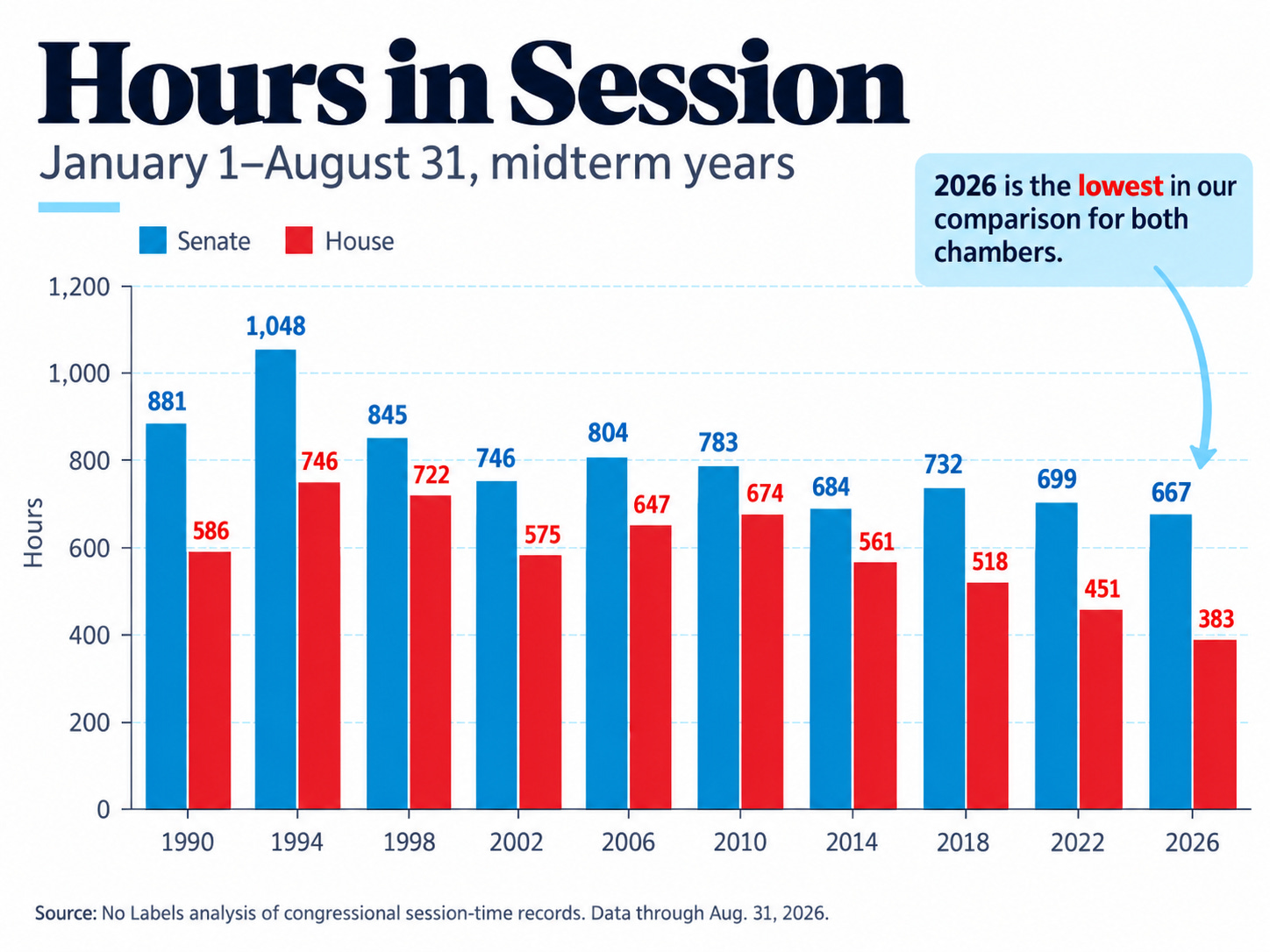
Through August, the House had spent 383 hours in session this year, the lowest total going back to 1990.
The House had logged 451 hours by the same point in 2022, 518 in 2018, 674 in 2010 and 746 in 1994.
That 1994 comparison is especially useful. The House actually held votes on fewer days that year—57 compared with 65 this year—but still managed to spend almost twice as many hours in session: 746 versus 383.
The Senate has been busier, but it is down too. Senators spent 667 hours in session through August 31, 2026. That was also the lowest total among the midterm years in recent history. The comparable number was 699 hours in 2022, 732 in 2018 and 1,048 in 1994.
One big caveat here: these are floor hours, not a congressional timecard. Members also attend committee hearings, meet with constituents, handle casework, travel their districts and do plenty of other things that don’t happen on the House or Senate floor.
Still, the floor is where Congress ultimately does the thing only Congress can do: vote.
And Congress hasn’t passed much, either
Maybe lawmakers were just being incredibly efficient with all that limited floor time?
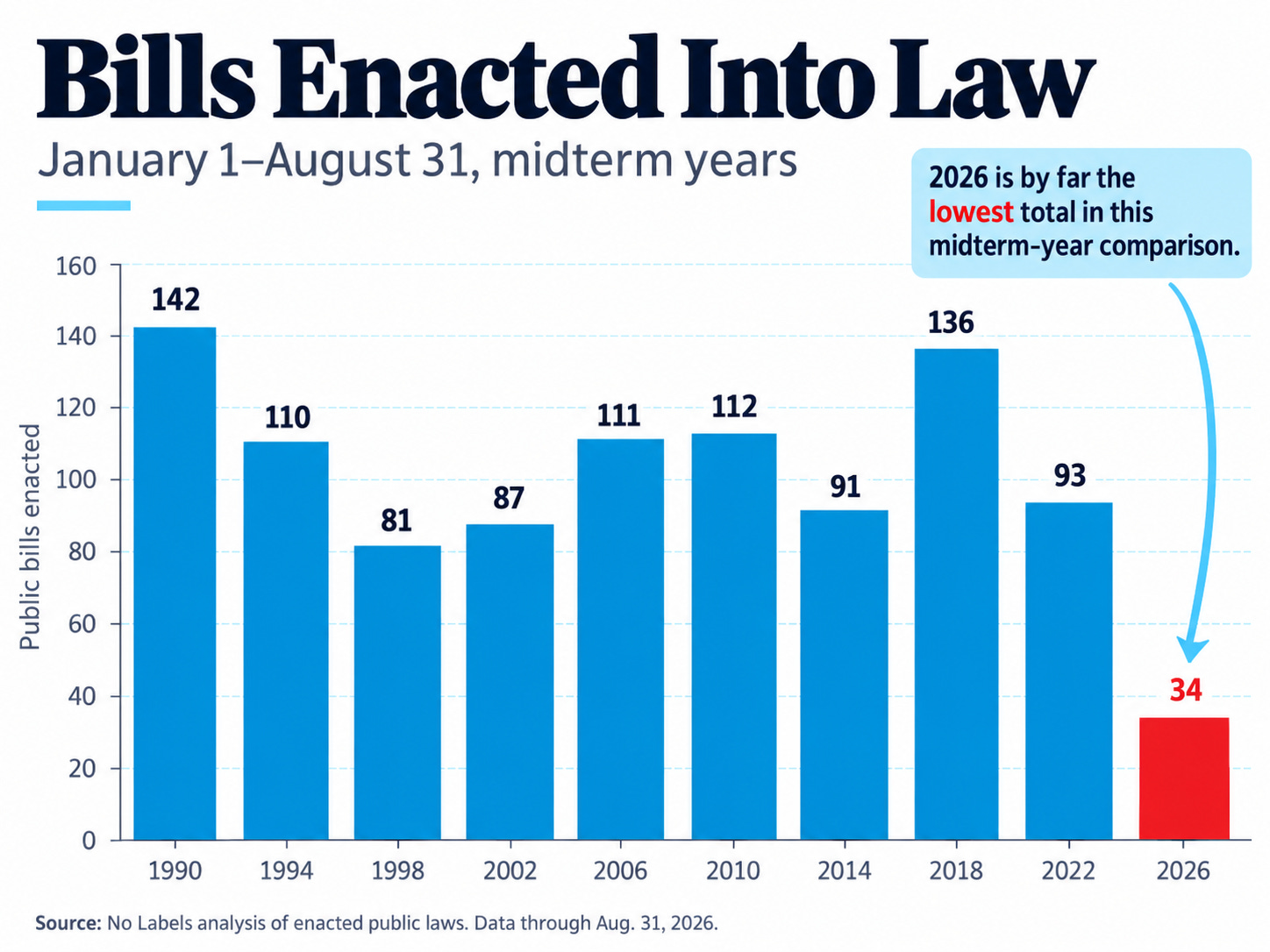
Nah. Through August 31, Congress had enacted 34 public bills into law.
At the same point in 2022, it had passed 93. In 2018, 136. In 2010, 112. And in 1990, 142. The 2026 total is the lowest of any midterm year in No Labels’ comparison going back to 1990.
And those 34 aren’t exactly 34 Social Security Acts.
One of them authorized putting a time capsule in the Capitol Visitor Center, to be opened in 2276 for America’s 500th birthday.
None of this means members of Congress spend every recess day sitting poolside. “District work periods” exist for a reason. Members meet constituents, tour businesses, hold events and work cases back home.
But this particular recess has another purpose that nobody is really hiding.
It’s campaign season.
The House has now left Washington for 53 days, with every member up for election on November 3. The Senate is gone for most of October, too. Both chambers return November 9.
So Congress will eventually come back. Just after voters decide who gets to keep working there.