


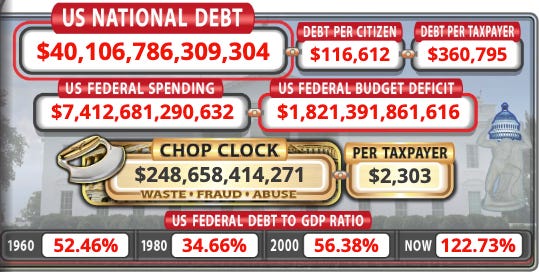
The United States now owes more than $40 trillion. Congrats, America, we did it.
If you’re like most, $40 trillion is one of those numbers so large that it doesn’t really meaning anything. A million dollars? I can picture that. A billion? Getting tougher but still a real number. Forty trillion? Might as well tell me we owe 14 bajillion.
So let’s make this useful.
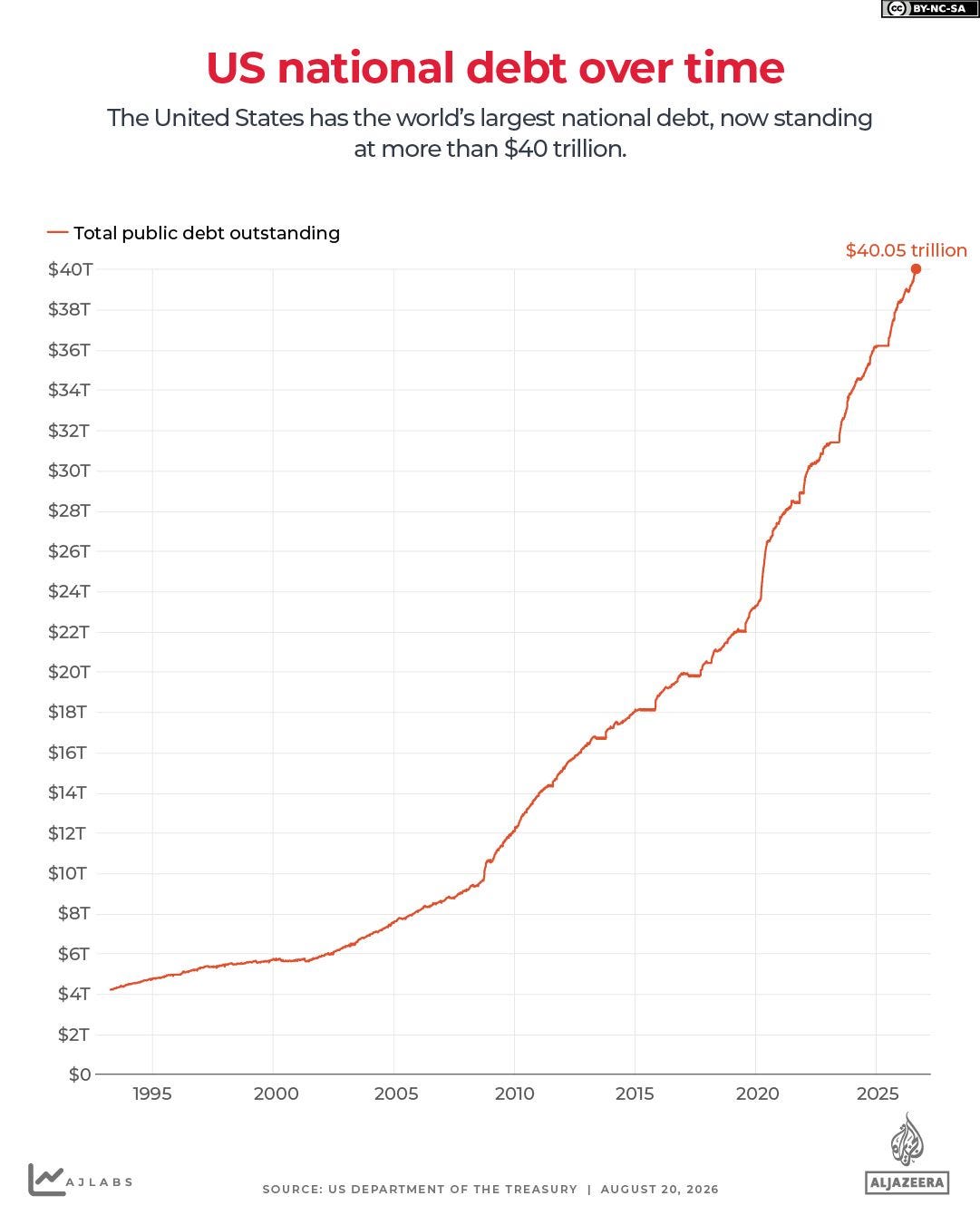
The national debt crossed $40 trillion for the first time in August, according to the Treasury Department. For context, it was about $20 trillion when Donald Trump first became president in 2017. In other words, the federal debt has roughly doubled in less than a decade.
But what does America owing $40 trillion actually mean? And who exactly are we paying?
First, how did we get $40 trillion in debt?
The math is pretty simple.
Every year, the federal government collects money, mostly through taxes—personal, corporate, etc. Then it spends money on Social Security, Medicare, the military, Medicaid, veterans, federal workers, roads, interest on old debt and roughly a billion other things.
When Washington spends more than it collects, that gap is the deficit.
To cover it, the Treasury borrows money by selling government bonds. And all of those accumulated deficits add up and become the national debt.
This year alone, the Congressional Budget Office expects the federal government to spend about $7.4 trillion while collecting only $5.6 trillion, leaving a deficit around $1.9 trillion for this single year. Over time, those annual deficits have accumulated to total the crazy $40 trillion.
Who do we owe all this money to?
No, mostly not China. I know you were thinking it. China holds about $633 billion in Treasuries—less than Japan and the United Kingdom, and only a small piece of the roughly $40 trillion total federal debt.
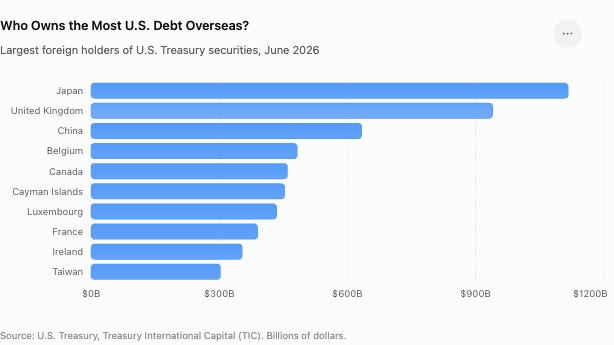
When the government needs money, Treasury sells securities—basically IOUs—to investors. You give the government money today. The government promises to pay you back later, with interest.
Those investors include foreign governments and investors, but also American pension and mutual funds, banks, insurance companies, the Federal Reserve, and individual investors like your grandparents who may have gifted you a government bond as symbols of patriotism and civic duty.
Of that $40 trillion, about $32.3 trillion is debt held by the public.
The other roughly $7.8 trillion is money the government technically owes to itself through federal accounts and trust funds. Think Social Security collecting more payroll taxes than it needs in a particular year and investing the surplus in Treasury securities. Treasury now owes that money back to Social Security. Yes, the government has IOUs from itself to itself.
So when someone says every American personally owes $100,000 or whatever number is making the rounds, don’t start looking for a Venmo request from Uncle Sam. Federal debt does not work like a household credit-card bill.
Then why should I care?
The main answer is interest rates.
For years, Washington could borrow huge sums relatively cheaply because interest rates were low. And if you’ve been awake for the last several years you know that has changed.
Now the government has a gigantic amount of debt and borrowing costs are higher. Treasury estimates interest costs are running around $1.1 trillion per year, and during the first 10 months of this fiscal year, interest payments actually exceeded Medicare spending. Only Social Security cost more.
That means an increasingly large chunk of the federal budget goes toward paying for things we already bought rather than anything voters are getting today.
And unlike a road, aircraft carrier or Social Security check, an interest payment doesn’t give Congress much to brag about back home.
There is another problem. As old government debt comes due, Treasury generally pays it off by issuing new debt. If the old loan carried a 2 percent interest rate and the replacement costs 4 or 5 percent, Uncle Sam’s monthly payment just got a lot more expensive.
Keep doing that across trillions of dollars and things get ugly pretty quickly.
Whose fault is it?
Take your pick. Trump didn’t create the problem. Biden didn’t either. Nor Obama, Bush, or Clinton.
The debt has grown under presidents and Congresses controlled by both parties. Republicans have passed large tax cuts without matching spending reductions. Democrats have supported major new spending and haven’t achieved the tax increases to pay for it. Both parties spent enormous sums responding to COVID. And neither party has shown much appetite for seriously confronting Social Security and Medicare, which consume huge and growing portions of the budget as the population ages.
About one-third of the debt increase over the past decade came during the enormous COVID borrowing under Trump and Biden. But even without a pandemic, Washington has been running large structural deficits for years.
Are we about to go bankrupt?
No.
The federal government is not a household, and the United States can borrow in its own currency. Investors around the world still buy U.S. Treasury securities because they remain among the safest assets available.
So hitting $40 trillion does not trigger some automatic economic explosion.
There is no magic number where $39.9 trillion is fine and $40 trillion causes the lights to shut off.
The problem is the direction. The debt is going up faster and faster.
CBO projects debt held by the public will rise from about 101 percent of the entire U.S. economy this year to 120 percent by 2036. Interest costs are projected to more than double to $2.1 trillion annually.
That leaves future Congresses with some spectacularly unpopular options: raise taxes, cut spending, slow the growth of programs like Social Security and Medicare, or keep borrowing and hope the economy grows fast enough to keep up.
For decades, Washington has mostly chosen that last one. Forty trillion dollars later, you can see how that’s going.
Great analysis! But tariffs will magically pay this down, and fast! Right??
Great job, Casey. Think lawmakers have the courage to do something about this, other than kicking the problem down to the next generation? or, wait, maybe give billionaires another tax break!