


Midterms elections are basically political gravity tests. Every two years, voters get a chance to check the president. And for more than a century, that check usually comes in the form of lost House seats.
History isn’t destiny. But it rhymes. And if you’re looking for a crude, back-of-the-envelope way to think about what November might hold for President Trump and congressional Republicans, history gives us a pretty clear baseline.
A quick Crash Course.
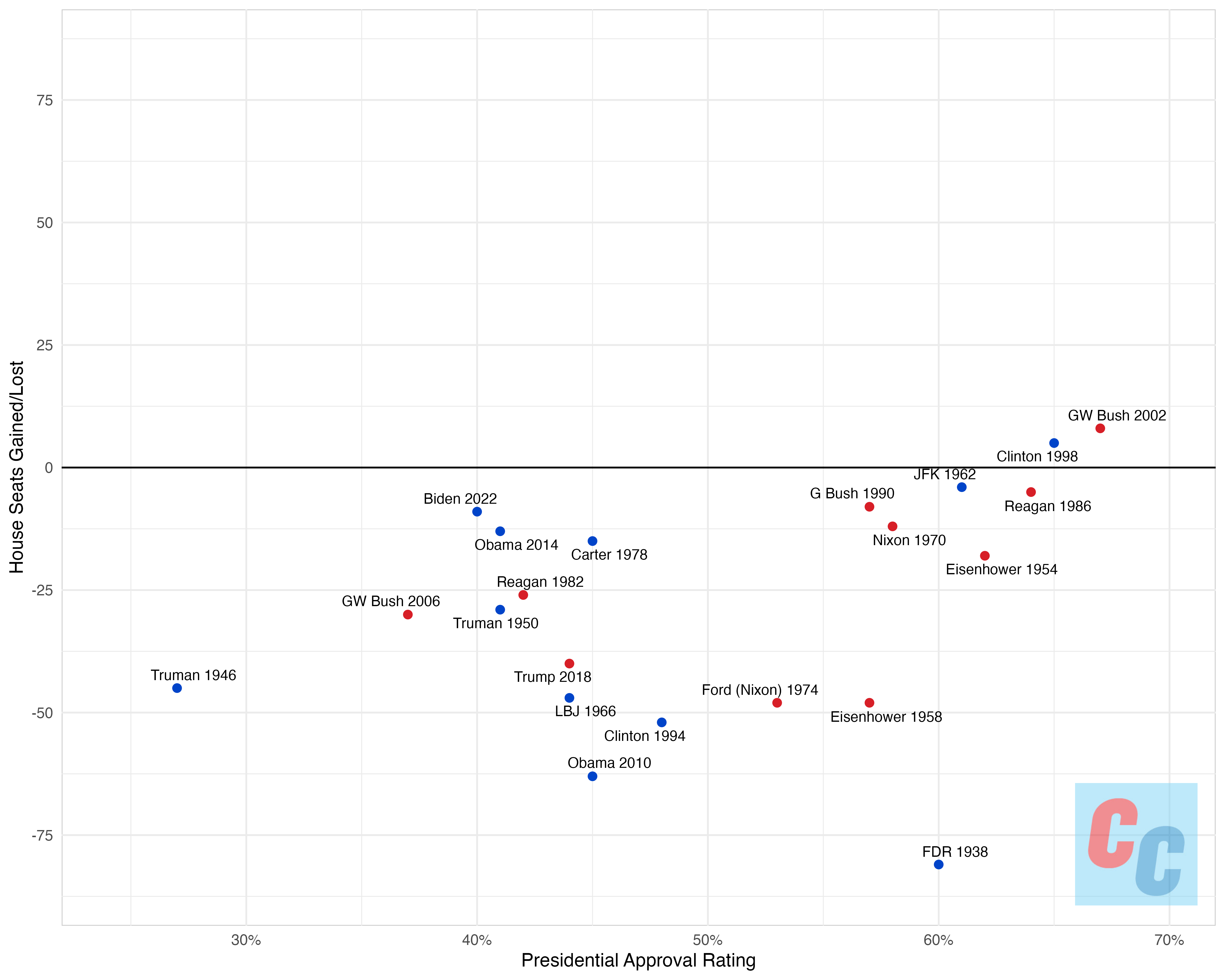
The Historical Pattern: Midterms Are Rough on Presidents
Since 1934, presidents of both parties have:
Lost House seats in 87% midterm elections (20 of 23 elections)
Lost an average of roughly 27 seats in those elections
Only gained seats three times
Those rare outliers?
1934 – FDR (+9)
1998 – Clinton (+5)
2002 – George W. Bush (+8)
Everything else ranges from mild bruises (-4, JFK ‘64) to absolute whoopins (-63, Obama 2010).
Presidential Approval — A Useful (But Imperfect) Clue
One simple predictor we have is the president’s approval rating heading into the midterm.
Higher approval → smaller losses (rarely gains)
Lower approval → bigger losses
It’s not perfect but does give us a good stat: no president with an approval rating below 65% has gained House seats in a midterm election. Notta one. And gone are the days of even 50%+ approval ratings.
Trump today: 42% approval, well below the 65% mark.
That puts him squarely in historical danger territory, with the potential for major losses come November.
Trump Has Been Here Before
In Trump’s first midterm (2018):
Approval: 44%
House result: –40 GOP seats
House majority flipped to Democrats
Different political environment, different economy, different Trump, different country—but same structural forces and potentially even bigger political headwinds.
Why Even Small Losses Matter
Republicans currently hold the House 218–214.
That’s a margin of four seats.
Which means:
A net Democratic gain of just 4 seats flips the House
A historically “small” midterm loss becomes a governing earthquake. And for context, Biden had a 40% approval in 2022 and Dems lost 9 seats and their House majority.
JFK lost 4 seats in 1962 with a 61% approval rating.
Given the razor thin majorities today, presidents don’t need a 2010-style wipeout to lose the chamber; they barely need a ripple.
The Generic Ballot Is Flashing Yellow
Democrats currently hold about a 5.5-point lead on the generic congressional ballot (who voters say they plan to support for Congress overall).
Historically:
When one party leads the generic ballot by ~5 points, they almost always win the House.
Again: crude indicator. But directionally important.
Why History Usually Works This Way
Midterms punish presidents for:
Inflation, cost of living, gas and grocery prices—”it’s the economy stupid”
Immigration and border conditions
High-profile scandals
Legislative failures or broken promises
Foreign wars and global instability
Midterms become a national referendum, mostly on the president.
It’s less “Do you like your representative?” and more “How do you feel about the country right now?” And Americans have proven more than willing to try the other party after two years of one.
The Governing Consequences
If Democrats retake the House:
Trump’s legislative agenda largely stalls
Investigations ramp up
Budget fights become even more frequent
Executive actions become more attractive to the White House since going through a Democratic House will demand bipartisanship.
In short: Gridlock goes up. Presidential unilateral action goes up with it.
The Takeaway
If Trump’s approval doesn’t climb meaningfully, history suggests November won’t be kind to House Republicans—and in a chamber this evenly divided, even a modest breeze could flip control.
I hope you're wrong but I fear you're right!
I like the sound of this!