


Last night’s State of the Union will generate plenty of hot takes. This isn’t one of them.
Instead, consider this a Crash Course in the speech itself—where it came from, how it works, and a bunch of weird, fascinating facts you probably didn’t know.
Article II of the US Constitution says the president shall “from time to time give to the Congress information of the State of the Union.” It does not require an in-person address, a prime-time slot, or a televised spectacle.
George Washington delivered the very first annual message in 1790 — and it was very short, just over 1,089 words. For context, the preliminary word count of Trump’s 2026 STOTU is 10,599 words.
Thomas Jefferson disliked the in-person ceremony and switched to written messages that Congress read to itself, instead. This practice lasted more than a century until Woodrow Wilson revived the modern, in-person State of the Union speech in 1913.
The phrase “State of the Union Address” became common during the Truman administration. Prior to that the speech/message was referred to simply as the President’s Annual Message.
The first radio broadcast of the address was in 1923 under Calvin Coolidge.
The first televised State of the Union was in 1947 under Harry Truman.
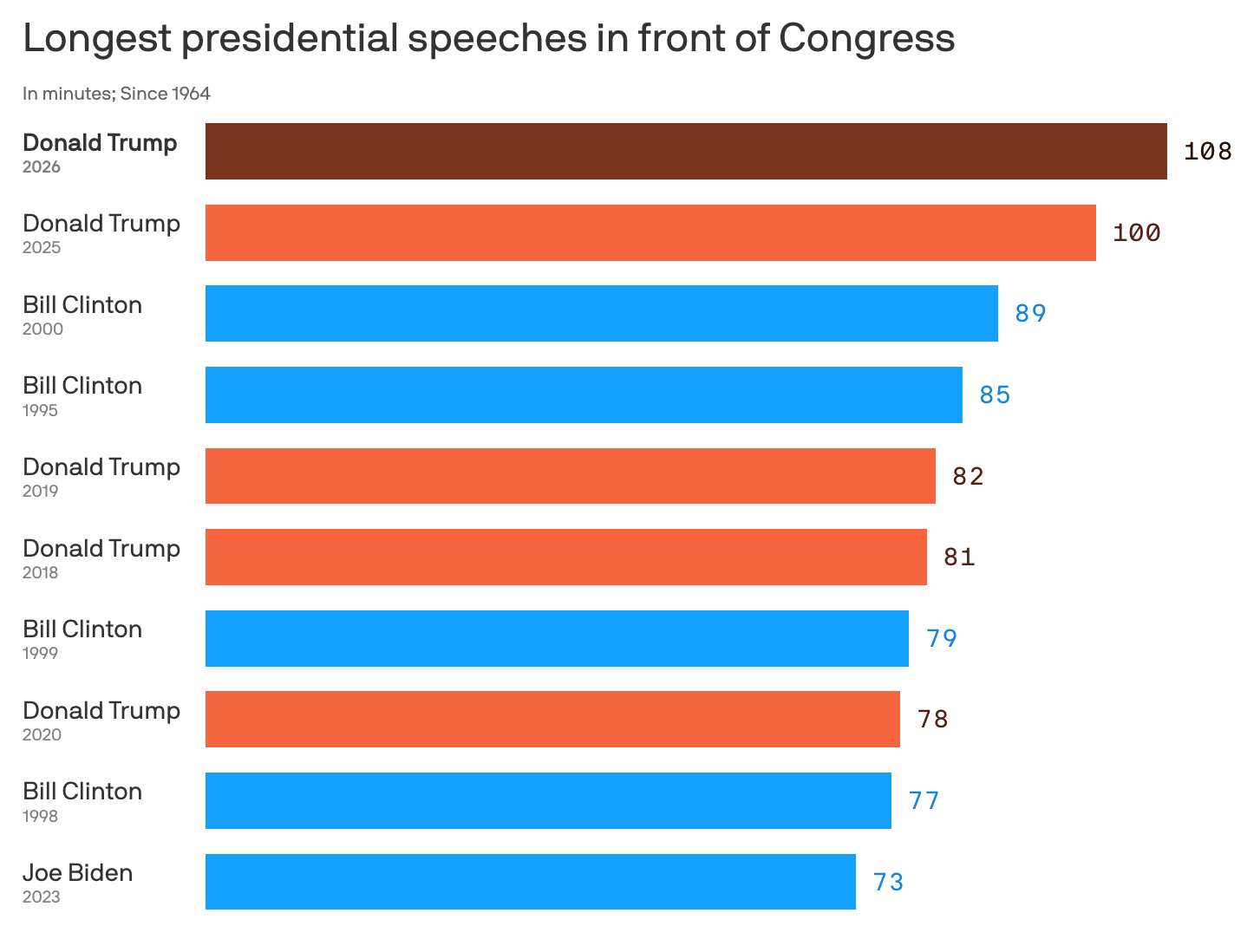
Trump’s 2026 address ran 1 hour and 48 minutes, making it the longest State of the Union on record in delivery time.
Source: Axios.com Members of Congress can each bring one guest, and both the speaker and vice president have separate guest invitations reserved.
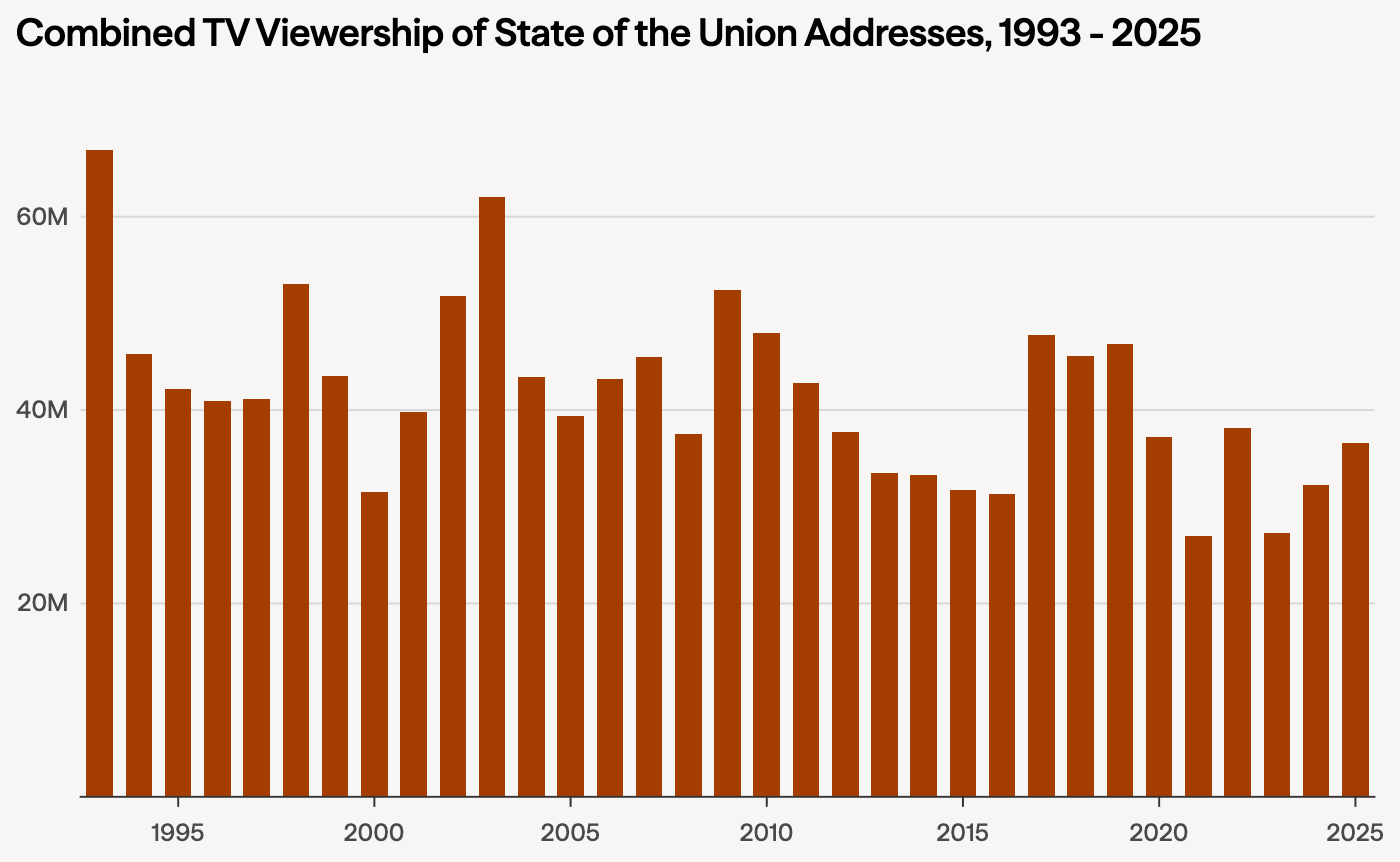
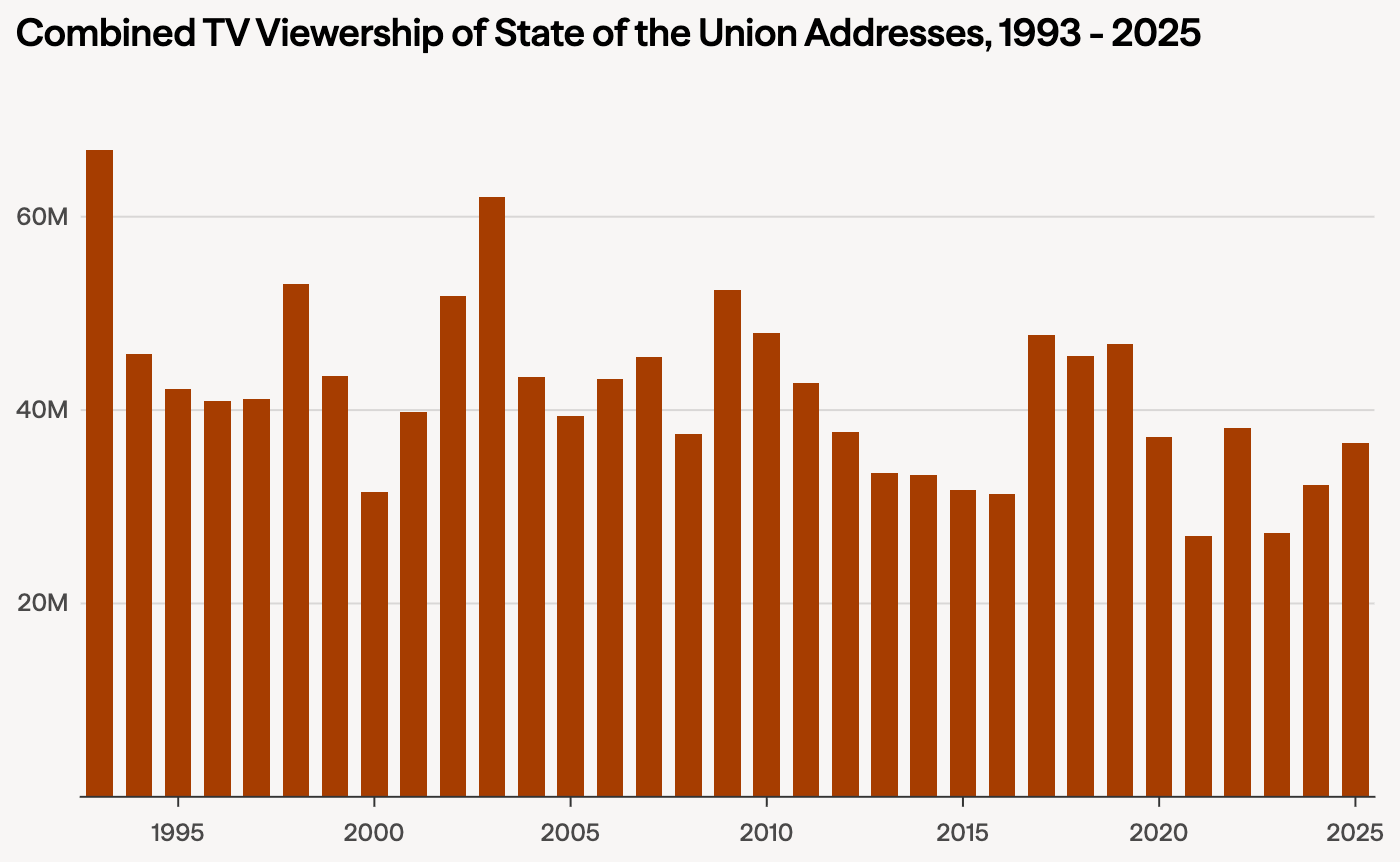
Though technology has broadened access (radio, TV, internet), fewer Americans watch now than in the 1990s, showing the address is no longer the “must-see” event it once was.
Bill Clinton’s 1993 address — technically not a State of the Union but treated like one — drew nearly 67 million viewers, the largest TV audience.
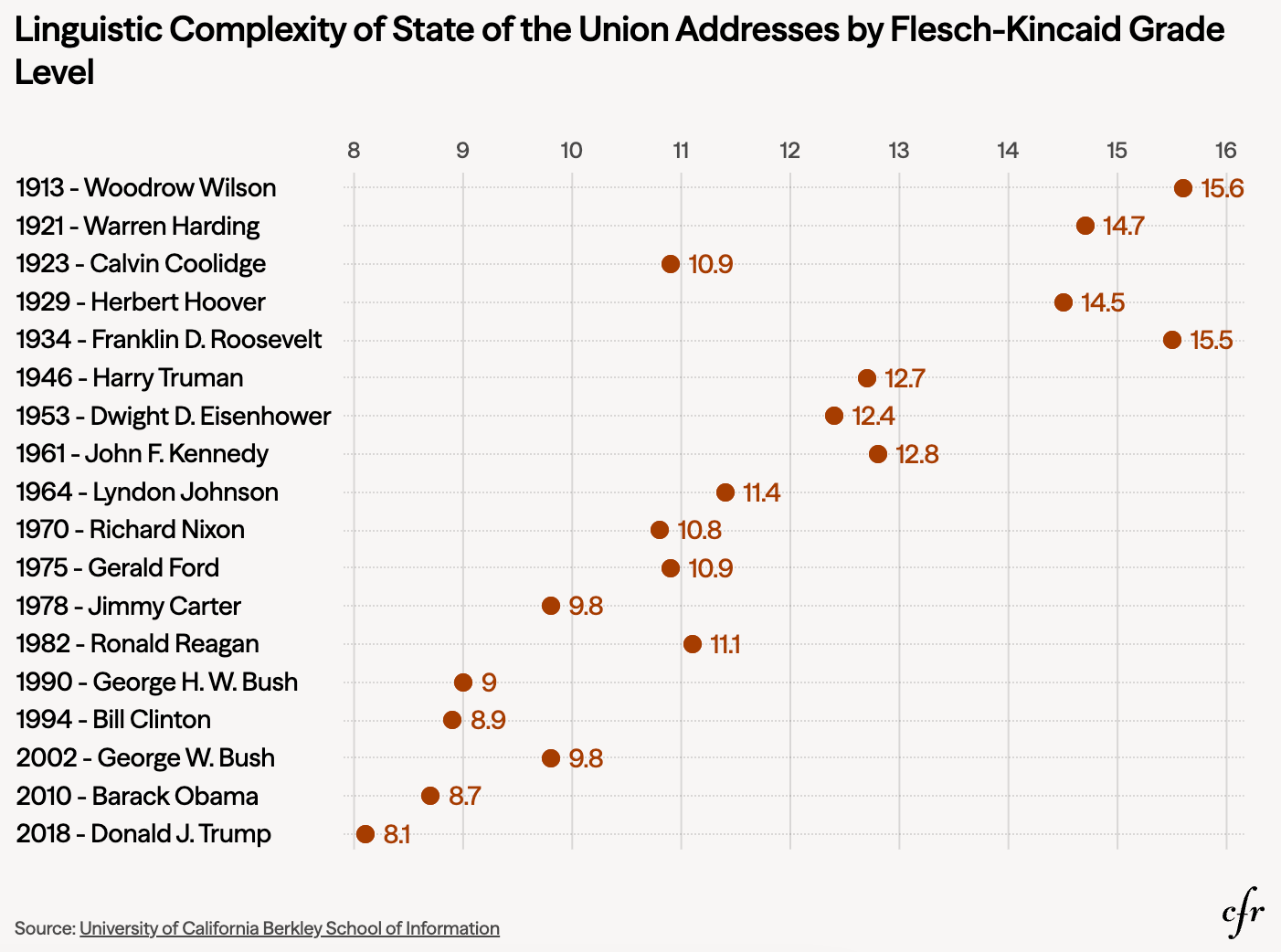
Over time, the linguistic complexity of addresses has declined. Early presidents spoke at what would now be considered college-level; modern ones tend toward eighth- or ninth-grade readability.
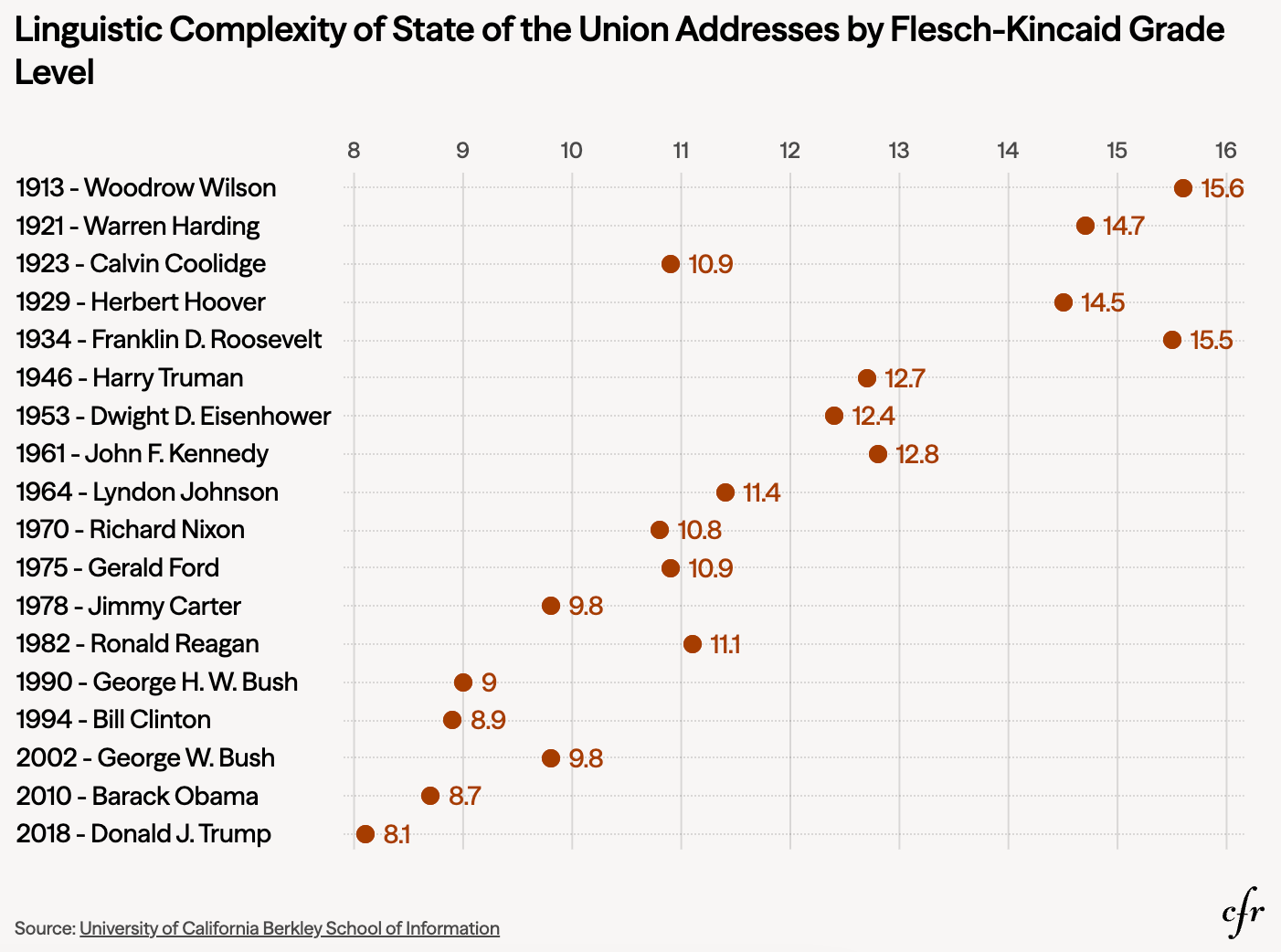
Unsurprisingly, Woodrow Wilson—a PhD and former president of Princeton University—gave the most linguistically complex State of the Union on record.
Most State of the Union speeches fade quickly. But when one sticks in history, it’s often because of foreign policy. James Monroe used his 1823 address to announce the Monroe Doctrine. Theodore Roosevelt expanded it in 1904. Franklin D. Roosevelt introduced the “Four Freedoms” in 1941. And George W. Bush labeled an “Axis of Evil” in 2002.
Before the speech begins, the president hands two physical copies to the Speaker of the House and the vice president. It’s a small ritual with big meaning: it formally satisfies the Constitution’s requirement that the president report on the state of the nation and ensures Congress receives an official written record of the agenda.
Only two presidents never delivered a State of the Union address. William Henry Harrison died just weeks into his term in 1841, and James Garfield was assassinated in 1881 before he had the chance.
Very interesting indeed. At some point I'd like to know what actual policy or policies ever came out of a STOTU speech. Obama's health care perhaps? I did not watch one minute of it.
Interesting— #11 on linguistic complexity really struck me. It seems the SOTU used to be communication from the President to Congress, but now the main audience is the public. Is that what you’re seeing? What are the implications of that shift?